VR can be extremely isolating.
Developers toil away for days, weeks or months at their desks with little contact. Often, the VR software they develop doesn’t help. The experience they’re building can isolate a person in a universe occupied by exactly one person for dozens or even hundreds of hours.
Sometimes this solitude can be part of the charm and lure of good VR. Half-Life: Alyx, for example, completes its transportation to City 17 by taking people there totally unbothered by anything or anyone else. More often than not, though, the headset needs to come off fully for a momentary interaction with someone in the physical world looking to ask a question or see how they’re doing. Only the Apple Vision Pro currently features system-wide people detection, for example, allowing the wearer to set the conditions when someone present in the same physical space can pop into a virtual environment. And still, this solution only solves half the problem. It brings people together but doesn’t give them a shared understanding of the digital environment. Why can’t a person point their iPhone or Android at someone in a headset and make a request to join a shared reality?
“My ultimate vision of VR…is copresent, multiplayer, whatever you want to call it by default,” said Owlchemy Labs head Andrew Eiche in an interview about his game Dimensional Double Shift, which opens its next dimension next month. “It’s not a metaverse. I think that’s where we keep getting hung up is like you push [players] the wrong way. You push them into a product….no, the operating system is copresent. So I can join you, Ian, in the default space. And then you go, ‘Hey, let’s jump into Dimensional Double Shift.’ And you open Dimensional Double Shift and it knows that it’s on my headset and we go together into Dimensional Double Shift. And if I’ve never made an avatar, it automatically takes the hyperrealistic avatar, converts it, and I hit a button or two and boom, now we’re in that experience together. And then we play that for a while. And then you go, “hey, we should play Walkabout. And you open Walkabout together, we jump to the next experience. It is a shared platform…stop trying to make a second place for me to make my games. Just make the operating system work, copresent.”
No other headset but Apple’s even solves the first problem of people sharing the same space across a decade of consumer VR and the $3,500 device is out of reach for too many for the benefit to have wide impact just yet. On every other headset, and in every experience, it is entirely up to each developer to provide multiplayer of any kind, and they largely have to explore without tools, guidance, or support.
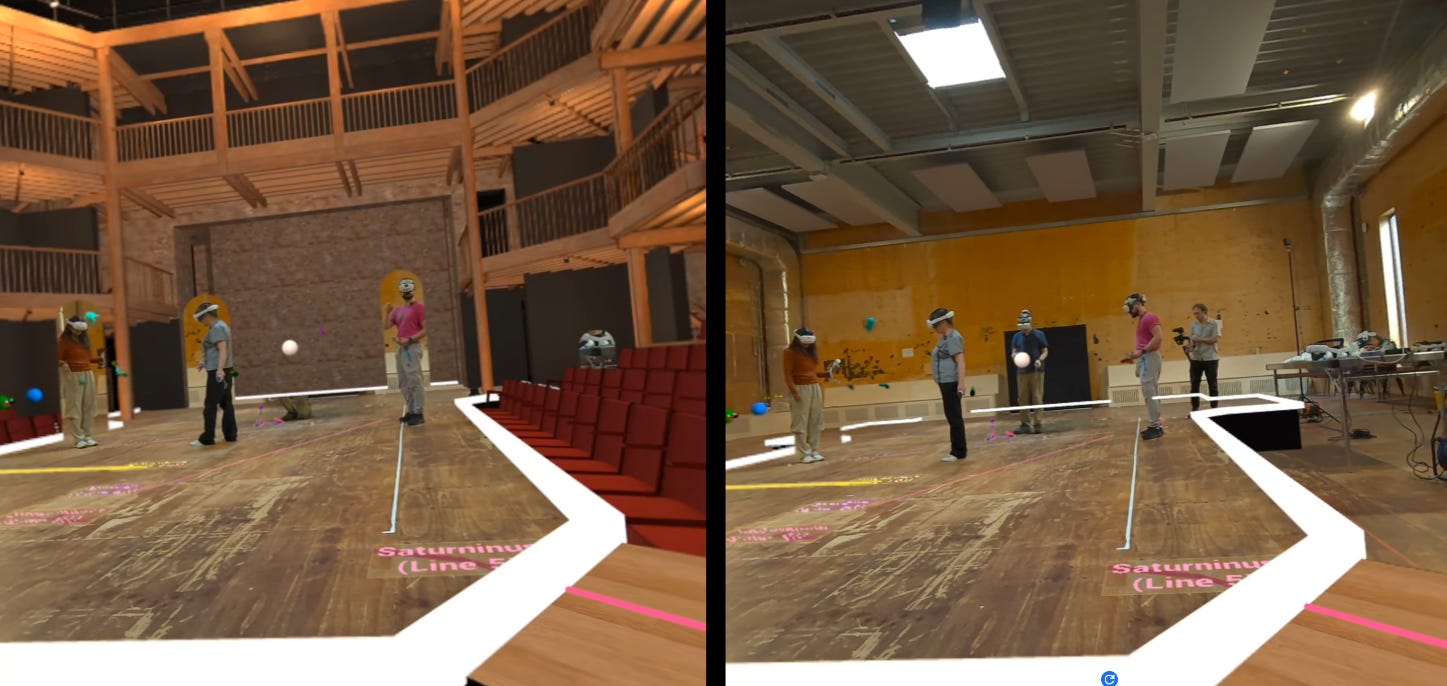
This is the space in which Steve Lukas and Alex Coulombe are pioneers. Each of them embrace the concept of BYOH — Bring Your Own Headset — as I attended events recently with my headset in tow to try colocated experiences from them built in Unity and Unreal. Not only are they working to colocate people both physically in the same space, as well as those who are remote, they’re working to lock virtual content to the same location as well so that everyone shares the same reality.
“VR can be a very isolating experience,” Coulombe said during the Good VR podcast. “And I think it definitely has a stigma around that to the public where, yes, you’re alone in an experience and you go through it and it might be an amazing experience, but you are inherently alone. And colocation, both in its physical on-site version as well as its remote version, is what brings us together. It’s what allows us to have amazing shared experiences that otherwise would be impossible.”
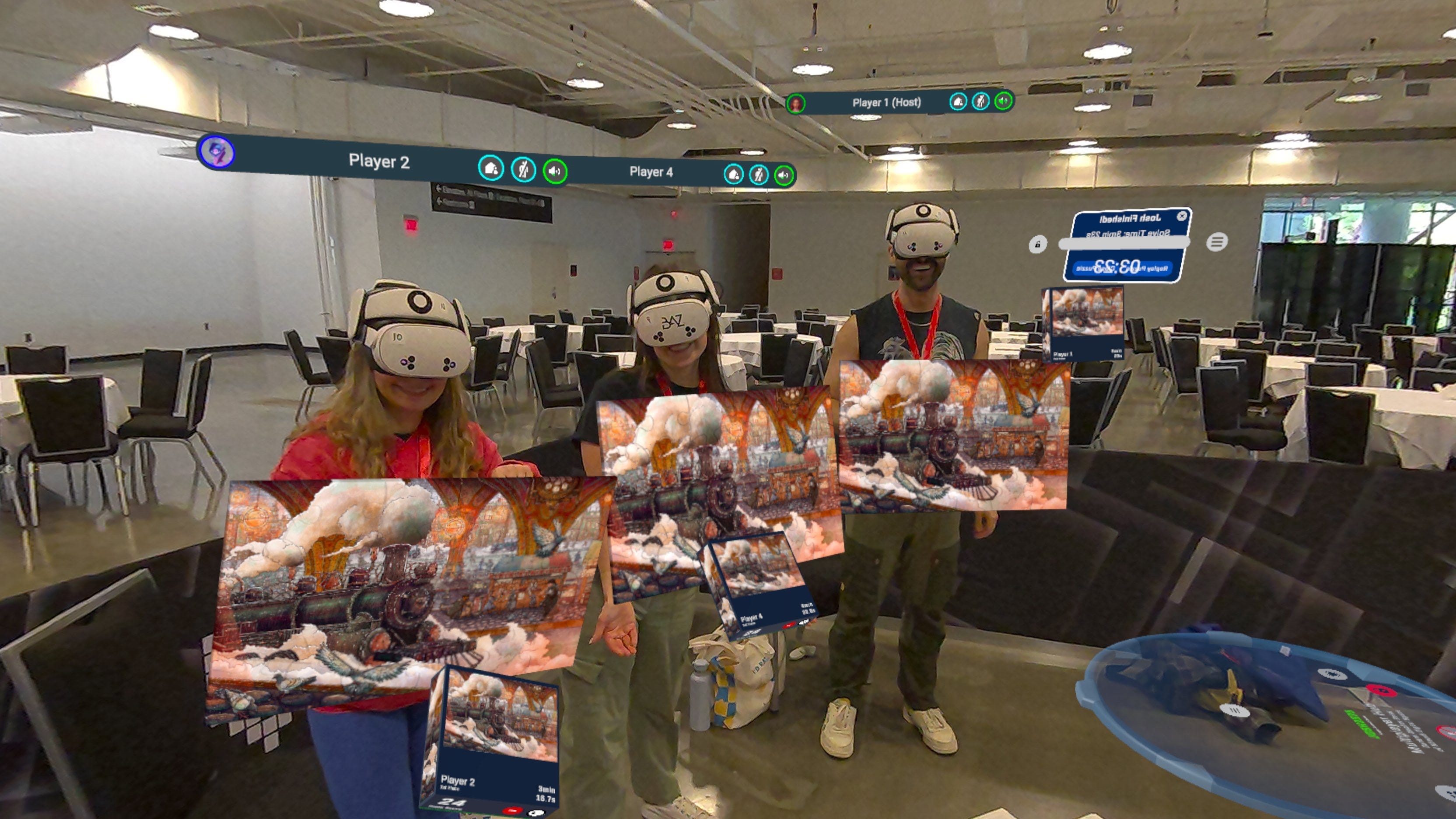
Lukas’ app Jigsaw Night is a simple idea to recreate the social experience of jigsaw puzzling in a VR headset, but the components he’s adding to his app have never been built before. The latest versions of his software allow colocation of media and people across both iPhone and Quest 3.
“When you look at colocation, what that means is that we’re looking at leveraging the people in our surroundings to provide us with that activity and entertainment,” Lukas said. “Humans have been doing this since the dawn of time. You grab a piece of paper, you get a pen, you got tic-tac-toe. You don’t need much more than people. And people play games like mafia or imposters, right? It’s just people talking. You don’t need rich environments, you don’t need artificial content, you just need to bring people together. What mixed reality does is that it gives us a canvas to work from where we can start with something as basic as a set of playing cards or what I’m doing is a jigsaw puzzle. Something basic that lets us engage with each other. But the industry is chasing bigger, flashier, and more spectacle, but when you can minimize it, and just bring us back to being able to engage with each other as human beings with basic digital content that just lets us engage in ways that we’ve never been able to do before, then that brings about a whole host of possibilities. And then you start to focus on what allows us to do these things together versus how many particles can I throw on the screen?”