

One day last decade I was driving my car in the early afternoon to a rented home in Corona, California from my job as technology reporter at the Orange County Register in Santa Ana.
That hellish drive could last anywhere from 45 minutes to two hours, depending on traffic, and I was trying to apply my best strategy to the worst of the 91 Freeway by finishing off the last bit of the day from my work laptop at home. I remember exactly where I was on that stretch of road when my editor at the Register called to say what crossed the newswires on March 25, 2014.
Mark Zuckerberg purchased Oculus VR for $2 billion.
The local startup I put on the front page of the business section of the Register in 2012 had become, two years later, the foundation of Zuckerberg’s ambition to build a computing platform that could rival those made by Google, Apple, and Microsoft. I’d have a writeup for the Register as soon as I could finish the drive, call a few people, log into the content management system, and take a few focused minutes to write my thoughts.
Below are three paragraphs I published for my front-page story in the Register on March 27, 2014:
“Jeff Norris, a computer scientist at NASA who has experimented with the Rift, thinks virtual reality will some day let people experience a Mars landing in a much different way than they did with TV and the first moon landing.”
“Cameras that see in 3D will map the Mars surface landscape and beam it back to Earth. Shortly after, people wearing goggles on Earth could stand in their living rooms and accompany a person in a space suit as they descend a ladder and leave a dusty footprint on the red planet.”
“In a demo Oculus shows off called ‘Titans of Space,’ you crane your neck upward and Jupiter towers above you, larger than anything you’ve ever seen. The scale shifts and Jupiter shrinks to just a small globe floating in front of a sea of yellow stretching as far as you can see in every direction. That’s how big the sun is in comparison.”
A New Mode Of Transportation
When I wear Vision Pro in my home I typically teleport to two places in virtual reality I cannot reach by any other means. I’ve even started mixing these places to get the best of both. The first place is the small moon Amalthea orbiting Jupiter and the second is an arcade set in the year 1989.
I’ve also worn Vision Pro in a cafe to play a digital board game without passing a device back and forth. I reluctantly pulled the headset out at the airport, and put AirPods in, to tune out the music playing over the terminal loudspeakers that was cutting out for five seconds every 20 seconds. I tuned out the discomfort of economy class, as someone over 6 feet, by wearing it through my flights. I wore a Quest instead of Vision Pro for a bus ride from Los Angeles to Silicon Valley only because I was on my way to Meta Connect and taking my preferred system to Zuckerberg’s event would seem a little rude.
In visionOS on Jupiter’s moon, I have nearly fallen asleep only to be startled awake by the light of a distant sun hitting my eyelids when it pops out from behind the planet. No real bother, in VR I can stop time altogether. In the absence of light on an OLED VR display, Jupiter appears like a black hole. I find the backdrop of a sun eclipsed behind a planet to be an unmatchable place for a cinema or arcade. When the sun shines on the side of the planet we can see, only patience might notice the clouds of the gas giant slowly churning. Speeding up time helps make that movement easier to see.
The newly released arcade is called Retrocade and it was made by Resolution Games for Apple Arcade. Retrocade’s architecture is measured as gigabytes of texture and light wrapped around kilobytes of gameplay producing a warm vibe with realistic reflections inside the arcade cabinets. The year 1989 is conveyed by narration in the arcade to set expectations and scope. Pac-Man, Galaga, Space Invaders and more classics are playable in the arcade and Apple even hid the original Russian version of Tetris in a secret back room.
In Retrocade, you don’t have to stand at any of the machines to play the games. You can if you want the added immersion, but it is easier to take the games out of the arcade and back out to Amalthea instead. I played Pac-Man for half an hour with my cat sleeping on my chest and his purring body between me and my game. I never stopped seeing the subtle yellow reflection of Pac-Man and his chasers visible even in the simulated metal rim around the virtual screen.
I’ve never known focus and escapism like I’ve found in an Apple virtual environment.
Forgoing Wear, Tear, Traffic, Tickets, Parking & Insurance For My Privilege
Presence delivered from a wide field of view optical path in virtual reality is the canvas upon which all software and experience can display. Whether it takes 5 more years or 15 more years or 50 more years to become mainstream, VR is the foundation of personal computing in the 21st century and it is the core concept enabling spatial computing from Apple.
My purchase of Apple’s first VR headset and abandonment of my car to afford it is a choice car brains cannot comprehend. That’s ok. I know the sense of freedom, exploration and escape ingrained by a century of car culture. I experienced that rite of passage at age 16 at the turn of the century, and then I spent more than 20 years wearing and tearing my way across the United States in assets that, by definition, become more dangerous the more miles they’re used.
I will never again be drawn into a speed trap nor will I need to drive defensively. I am giving up the privilege of spending precious hours of my limited life stuck in traffic and driving to or from my place of employment. I am abandoning the cost of paying insurance on the risk to my fellow Americans inherent to manual physical travel in a heavy rolling metal box. One of the Oculus founders was killed in 2013 in the crosswalk near my office in Santa Ana by a human-driven car. I don’t think about the statistics that show how dangerous cars are, I just think about what that skeptical voice might have said when Zuckerberg showed up to buy Oculus.
Nothing about what I’ve said here changes the reality that, for some, owning a human-driven vehicle means a locked door, roof over your head and a new start somewhere else when every other thing in a life has blown apart. VR can’t replace that kind of escape hatch and I am not suggesting others follow my particular path. I am not telling you to spend $3,500 to have this experience or to get rid of your car to have it.
But if you want to disagree with my overall premise here you are going to have to disagree with Mark Zuckerberg and Tim Cook too.
Traveling The Internet Instead Of The Interstate
In 2026, Meta, Google, Valve, Apple and Bigscreen all ship the same fundamental architecture for the display of software in a place people go via presence. The larger trend is the same as it has been since last decade, and all these companies race to the very same place — virtual reality.
In 2015, Mark Zuckerberg wrote internally to his lieutenants that “our vision is that VR / AR will be the next major computing platform after mobile in about 10 years.” In 2024, at year 9 of that 10 year timeline, Apple ended its car project and shipped a VR headset instead.
When it comes to Zuckerberg, consider the words he said in 2017 at Oculus Connect 4. I have listened to everything he says to developers at these events. His speech then, speaking for roughly 15 minutes, was the last time he had his hand directly on the pulse of the people who truly believe in this technology.
“If you can’t think of any way that your reality can be better, then you’re not thinking hard enough. You know? Take your work. How long is your commute every single day? Now I don’t know anyone who sits in traffic and thinks to themselves, man, right here, this is the best that reality can be. Now a lot of people have ideas on how to make transportation better. Alright, self-driving cars, hyperloops, and don’t get me wrong I love all of that stuff, but it’s 2017 and the biggest trend in transportation is that it’s a lot easier to move bits around than atoms.”
That same year Jeff Norris left NASA. Today, he works as Senior Director on apps and content in the Vision Products Group at Apple. He’s almost certainly had a hand in creating these places I love to travel in my headset and could never get to by car.
Here’s what he told me then:
“One of the things we’re investigating is the use of immersive displays for looking at data returned from spacecraft. We’re looking at virtual reality technology as a way for our scientists and engineers to better understand the environment around a spacecraft and then better control that spacecraft.”
“But we’re also looking at these technologies as a way to share the journey of these missions with the public. The fact that [inexpensive devices like the Rift] are becoming more accessible to a broader audience helps both those goals.”
“It’s now conceivable to put these kinds of devices in the hands of a whole mission science team. It’s also possible for us to imagine in the not too distant future millions of people in the public having these kinds of devices and being able to consume this data along with us.”
“If we put humans on Mars someday, we should have millions of people there with them standing beside them in this holodeck-like way. In 1969 the television was the most engaging and effective medium for bringing the world along. It was the perfect choice at the time. It’s not the perfect choice now.”
My body is ready. My headset is ready. The streaming and capture technology is ready.
The structures of society are not.
The Dream Of A Holodeck
I sold my car in 2024 to afford the purchase of an Apple Vision Pro. Today, that headset remains the most expensive thing I own. With the housing market the way it is and journalism the way it is, a headset may always be the most expensive thing I own.
I am a trekkie. My fandom for Star Trek colors everything I have ever done. The future I want my children to live inside is not in Mark Zuckerberg’s Metaverse, but in Gene Roddenberry’s Star Trek and experiences found on occasion in a Holodeck or Recreation Room.
Apple today makes PADDs, tricorders, universal translators, and if the folding iPhone doesn’t flip out like a Star Trek communicator I hope reviews of the hardware call out the failure.
In Vision Pro, I got my Holodeck.
CAVE Versus HMD
When I look back at my path of reporting from 2012 to 2026 there is one article I have to point to that might help contextualize the discovery of virtual reality better and help in conceptualizing what’s changing here from science fiction to fact.
There is at least one other delivery mechanism for VR other than an enclosed HMD. I visited one such facility at Disney’s Imagineering offices in 2012 in connection with the launch of Cars Land. Decision-makers at Disney could walk around a room and see the sight lines of their planned construction using projectors pointed at the walls, 3D glasses, and a hat tracking head movements. These sorts of facilities are called CAVEs and they existed only in expensive research labs, just like VR headsets, up to 2012.
If it could ever be economical to install a projector array in a room capable of beaming images at high frame rates with views matched to head movements for the enjoyment of a single person, we would have, instead of head-mounted displays, a holodeck that very closely resembles Star Trek’s depiction of virtual reality. Such a facility would also likely need to be enormous to do redirected walking of the sort imagined by the show. And, after all that, you’d still likely need to wear some form of shutter glasses to see stereoscopic 3D and none of this would solve for haptics.
For me, experiencing VR in that CAVE just a few months before donning a duct-taped proof-of-concept for an inexpensive head-mounted VR display showed me something important about time scales here. A true holodeck of Star Trek’s sort may still be more than 100 years away. It is an infeasible science fiction future technology like physical matter transportation and warp drive. What the Rift prototype showed, in contrast to this, was that a path to consumer virtual reality was not on that kind of timescale.
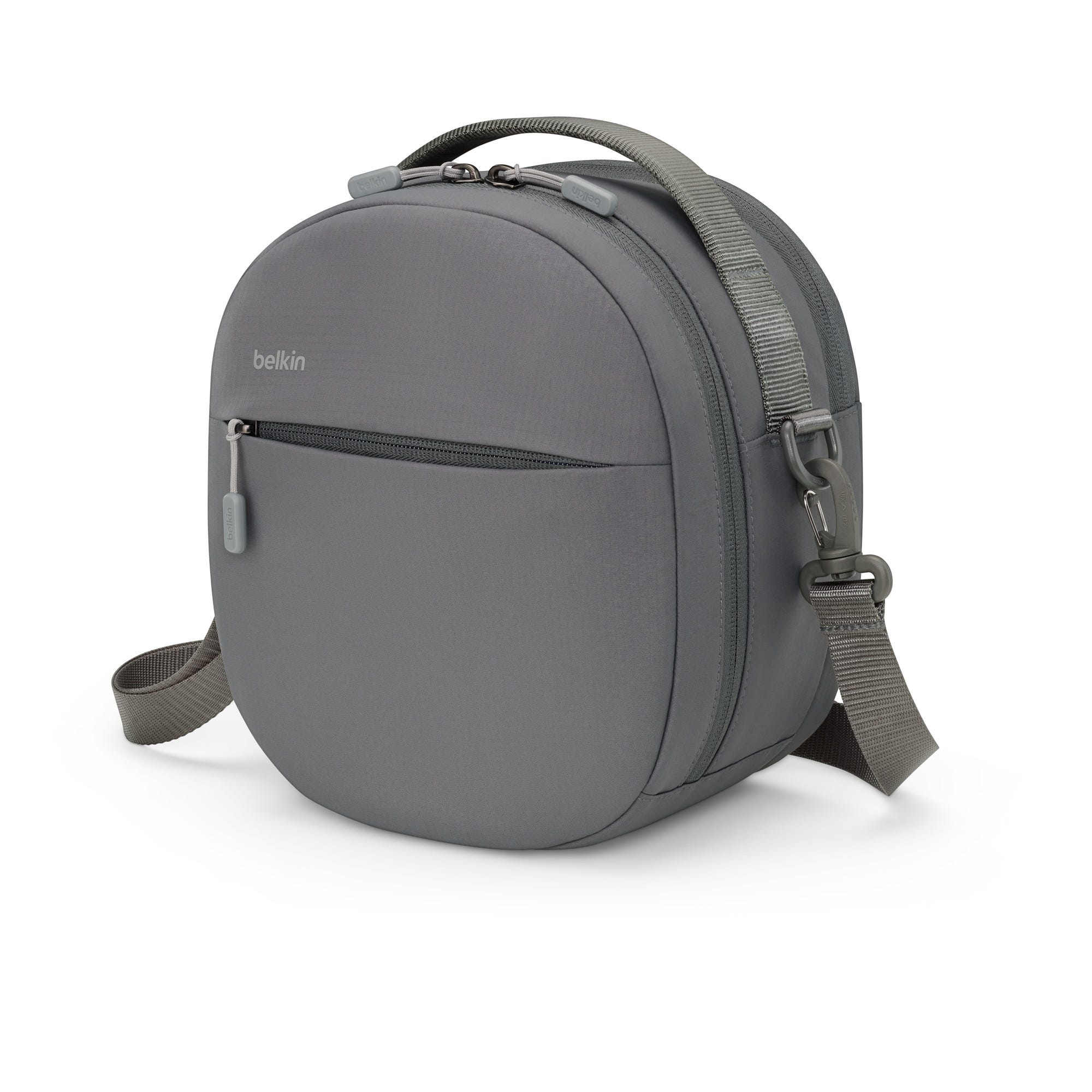
Today, I carry my holodeck in a Belkin shoulder bag almost everywhere, and I still shake my head when I read the following sentences from The Verge’s review of Vision Pro in 2024:
“But the shocking thing is that Apple may have inadvertently revealed that some of these core ideas are actually dead ends — that they can’t ever be executed well enough to become mainstream. This is the best video passthrough headset ever made, and that might mean camera-based mixed reality passthrough could just be a road to where.”
No, Vision Pro’s heavy design and the minimum viable “mixed reality passthrough” contained therein was necessary to close the experiential gap between what is done in a CAVE and what can be layered on top of presence in a wide field of view VR headset.
The dial on Vision Pro and the cutout of my arms by visionOS means I go from a purely physical environment in my view to a mixed reality space with augmented reality windows and objects I believe float in my room because of the presence found in the wide field of view optics. Apple engineered the technology of a CAVE into a augmented virtuality headset.
Apple’s engineers are so competitive in this fight for the future of computing that, even though they figured out how to put AR on top of VR, correcting for the failed optical path of Magic Leap and HoloLens, their efforts stand to gain much by simply not correcting the record at places like The Verge or anybody else. It enables their competition to hire grifters taking paychecks for managing metaphorical visions built on wordplay and branding rather than applying decades of research and NASA engineering to the science of product development.
I’ll end this piece about selling my car to travel sometimes in VR instead with one of the most important questions I’ve ever asked.
“A lot of people get confused that VR headsets are a transition until AR glasses. Are we going to have both in the future?”
In 2022, I met Michael Abrash at Meta’s research offices. He was hired in 2014 from Valve to become Meta’s top researcher. Whatever strategy Mark Zuckerberg and Andrew Bosworth attempt to employ by hyping AI and their “unshippable” Orion AR glasses must align with his answer.