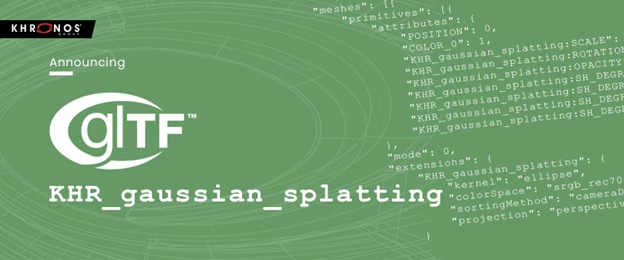
Industry standards group Khronos announced a release candidate supporting the storage of 3D Gaussian splats in the glTF 2.0 format.
Close watchers of the immersive industry will recognize Khronos and its standards body as the group behind OpenXR and an assortment of other technologies that help push forward interoperability and cross-platform development in VR headsets and augmented reality software.
For years now, I’ve suggested that full body hyperreal avatars of the sort Meta is pursuing as a “codec” for all human representation is the killer app of immersive technology. Put another way, 3D gaussian splats may ultimately be the key to consumer teleportation.
Meta is a research leader in this space even if Mark Zuckerberg’s need to be the social glue in VR hasn’t been able to put the technology in shipping consumer hardware. Persona visages from Apple on its Pro-level Vision headset are locked behind a scan of your eyes’ iris. Meta, meanwhile, I guess will attempt to connect the economics of verification ($15 per month without the purchase of hardware) to the storage of a representation of your face and body that cannot be worn by anybody else.
Ultimately, companies like Apple, Meta, Google, and Valve are on a collision course to repeat the blue bubble / green bubble chat fiasco dividing people into Apple and Android camps on their phones, but for the 3D animated representation of faces and bodies talking to one another in space. Now will they work out some system of interoperability and will Khronos play a role in that? Probably, but right now you have to choose FaceTime or WhatsApp to make calls in flat systems as the foundations are laid for spatial calling. The battle to be the dominant global technology provider of spatial calls and identity is why I imagine bad decisions keep getting made by Meta, like the closure of Echo Arena and the forced-linking of Facebook accounts.
Anyway, I specifically asked Khronos if this latest step was likely to help with the standardization of avatars. Here’s the full response from Neil Trevett, Khronos President:
“Gaussian splat avatars are already shipping on Apple’s Vision Pro Personas, and other companies have published extensively on the topic. What’s missing is cross-platform interoperability – and that’s what glTF will unlock. The KHR_gaussian_splatting extension establishes the common format for storing and exchanging Gaussian splat data across platforms, tools, and apps. Khronos is actively exploring how to extend glTF further to support avatar animation and streaming volumetric media — building out the standard that cross-platform splat avatars will require. glTF is how Gaussian splat avatars will become portable. Today the industry has agreed on how to store Gaussian splats; now it can work on how to animate and stream them.”