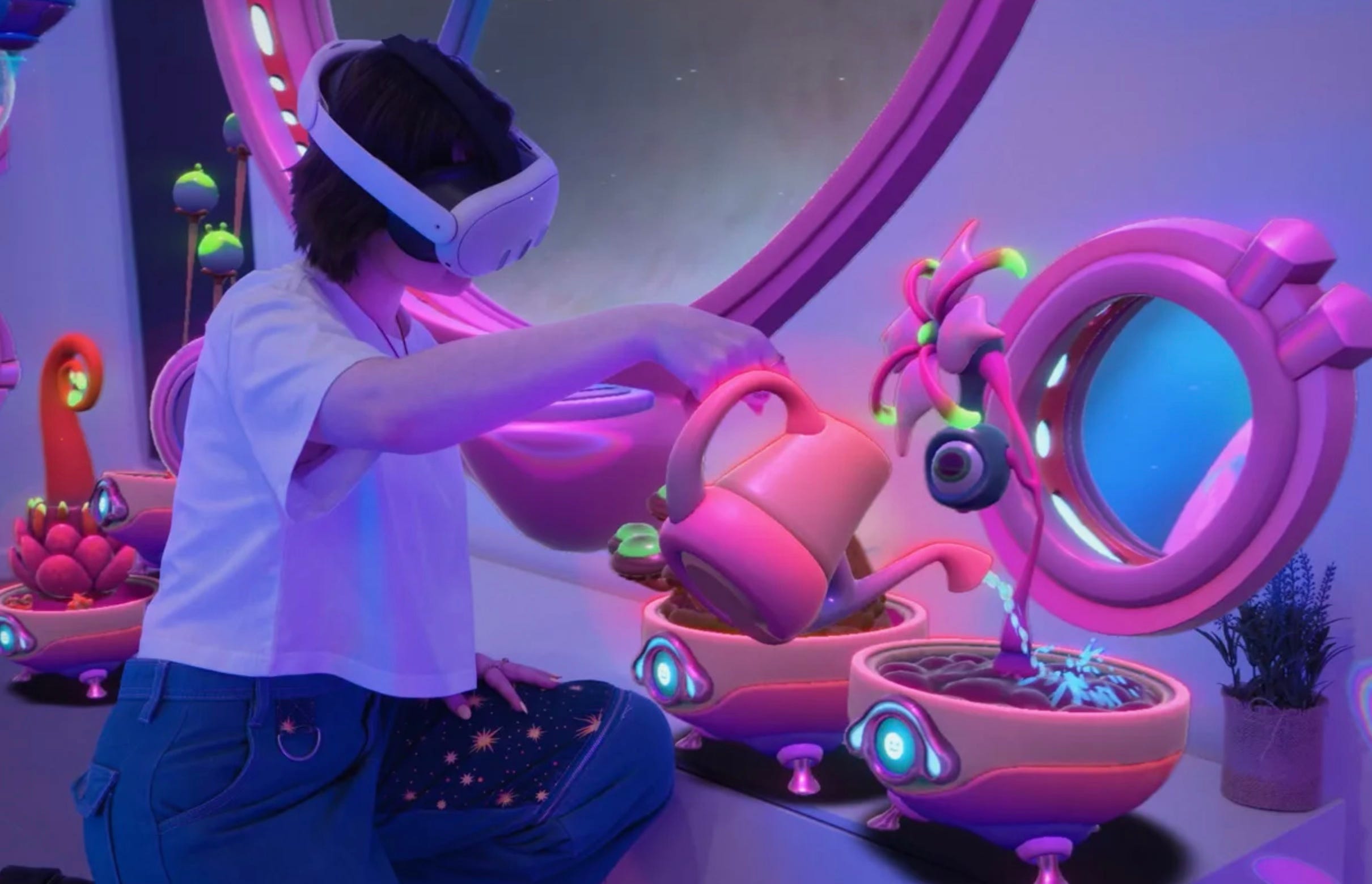
Doug North Cook is the most important developer working in virtual reality today.
In defense of my labeling, which drew critique from North Cook himself when I uttered my belief to him, let me walk you backward in time from the present day company he’s founded called Creature.
Creature lists on its website partner studios including Thomas Van Bouwel (Cubism and Laser Dance), Funktronic Labs (The Light Brigade, Fujii), Neat Corporation (Garden of the Sea, Budget Cuts Ultimate, Crossings), Puddle (Thrasher), Double Jack (Maestro), Trebuchet Studio (Prison Boss VR, Compass), Giant Stride (Adepts Arena), Flat Head Studio (Deadly Delivery), and Kettle Games (Wordbound). The label also released its Meta Quest exclusive Starship Home from its internal studio as a first-of-its-kind project for Quest 3 headsets that transforms your home into a mixed reality spaceship kind of like The Magic School Bus. The director of engineering for Creature is Mark Schramm, who was the lead developer on SUPERHOT VR and ported the title to Quest.
North Cook also has an academic textbook out now co-authored by Reginé Gilbert called Human Spatial Computing after helping launch one of the first four-year degrees for immersive design in the United States at Chatham University in Pittsburgh. Before Creature, he led VR work at Robot Teddy where he helped fund more than half a dozen titles including The Last Clockwinder, No More Rainbows, and Clone Drone in the Hyperdome.
Before that, North Cook did architectural visualization work and made a title called Forestry he released back in 2017 to mixed reviews.
“I’m a pretty poor engineer. I’m a middling programmer, and the role that I’ve kind of landed myself in for the most part now is that I see these people around me, many of whom are like my dear friends, who are capable of building some of the most incredible experiences that I think anyone has ever made, and I am just desperate to ensure that they keep being able to build those things,” North Cook said on a recent recorded phone call.
That’s why he’s the most important developer in the world right now.
Even beyond the developers who signed up directly with Creature, North Cook’s name comes up at the very center of a community anchored around the idea of independent developers pursuing presence and fun interactions you can have in a place called virtual reality.
Email clients might truncate the transcript below of our conversation which is sent first to paid subscribers of Good Virtual Reality. I’ve edited the transcript for clarity with key ideas bolded. You can find it in full on the website with the audio version. Thank you for your support.
Ian Hamilton
Hello everyone. Ian Hamilton here with Good Virtual Reality kicking off my first podcast with the voice of Doug North Cook joining me. North Cook is a double barrel last name for my listeners out there, and he’s the founder of Creature, a group that calls itself a label rather than a publisher or development studio.
Doug is perhaps the most important VR developer in the world right now. I am happy to debate that label with Doug himself here or with my listeners, but my hope is that through this conversation you’ll be able to gather why I think this might be true and why I’ve decided to begin my first podcast here for Good Virtual Reality with North Cook’s voice grounding us to the reality of the market and the difficulty of making good VR.
For those of you who have missed my voice and are hearing it again here, thank you for tuning in. Good Virtual Reality is an independent effort funded so far exclusively by the support of individuals. This podcast is for you. So Doug, those are my prepared remarks, and we can take this conversation anywhere you want it to go. This is the second attempt at this conversation because our first attempt didn’t record.
Doug North Cook
Yeah.
Ian Hamilton
How are you doing today?
Doug North Cook
I’m doing good, Ian, and I’m also, yes, this is our second attempt and you’ve read that same intro on the first attempt. And I was sitting here laughing just as hard the second time, at the idea that now I must live up to that introduction. So I’m gonna do my best.
Ian Hamilton
Alright, well let’s, let’s go over this. When did you first interact with virtual reality?
Doug North Cook
So, my first interaction with virtual reality, which I was just rehashing last week with one of the people that worked on this, was the Aladdin’s Magic Carpet Ride Experience at Disney Quest, which was a Disney kind of hybrid theme park arcade that they built in the early nineties.
And Jesse Schell, of Schell games, worked on that original attraction. I ran into him at the DICE Conference in Vegas last week and we talked a little bit about the Magic Carpet. And that for me was this moment of what I felt was fleeting magic similar to like going on a great amusement park ride.
I was like, wow, this is so cool. And I love this. I think I ended up riding it maybe two or three times while I was there, but the thing about that was that it never felt like it would be something that I would ever see again. Like I wasn’t like, oh, I’m going to see this technology again. It felt like something from another, another world and I was a child. And the next point that I saw virtual reality wasn’t until someone that I knew here in Pittsburgh got the first Oculus developer kit from the Kickstarter. And a group of us went over to his house. We tried some of those early, early demo scenes and early small prototypes.
And something flipped in my brain where I was just like, okay, I do this now. And what I actually did at that time is I was running a digital design agency. We were working mostly on interactive web and branding and whole bunch of basically anything using, like new interactive software that we could get our hands on to work on and I went to my team and I was just like, I’m done. And so I basically started parting out our clients, letting people take those, and I just devoted myself entirely to trying to build virtual reality experiences basically from, from that point on.
Ian Hamilton
So this is what I do now. Yeah. I love that quote. I love that way of describing the feeling. I believe anyone who has been in the market for this entire journey from 2012/2013 to now, probably had a similar reaction. And what I’ve noticed is those artists, those developers, those creatives that were inspired in 2012, 2013, found themselves interacting with platforms that tried to set themselves up in front of their inspiration. And it hasn’t gone so well in some respects, and it has gone well in other respects. I’d like you to try to break down what has been built in front of developers and how you’re trying to help with developers trying to deal with what has been built in front of them?
Doug North Cook
Oh, it’s a big question. I think the big thing that me and and my team have tried to stay focused on, and the different people that I’ve worked with over, over this past, you know, now almost 14 years is realism about what state of development we are in. And I would say there are kind of two or three critical points over those, those last 14 years where the hype cycle has gotten the better of everyone. And that’s, that’s for a huge number of reasons, right? We have the original Oculus acquisition by Meta, right? At which point a lot of other investors and big game studios, I think saw the money in that transaction, and they were like, excellent, now we can justify to our investors that we should engage in this technology. And so you have Meta, well then Facebook, investing in big AAA games for the headset that all driven by PC technology at the time. And the market doesn’t really take off the way that they expect. And then it’s really not until the Quest 2 and then the pandemic in 2020, where you have this moment where you have the only new video game console that is for sale and supply chain constraints on the PS5 and on PC gaming. And so the Quest 2 is cheaper than all of those. And it is in stock at retailers at a time when everyone’s looking for something, anything interesting to do while they’re locked at home.
And so VR just picks up massively, kind of all of a sudden and people see that that explosive growth, which was not explosive on the scale that it needed to get to, but it was explosive in comparison to where the market was just a year prior. And so that’s another point where everyone’s like, if this growth stays sustained, then it becomes the new computing platform, right? It is the biggest thing. It gets massive. And so Meta helps to build that narrative by projecting this concept of the metaverse onto the technology, right? That we can have a digital twin of the real world, not an actual twin, but like some sort of strange secondary version of the world where that’s where we all interact.
That’s where we play and that’s where we work. They show this vision of a world in which people are spending potentially the majority of their time using one of these devices to work, play, and connect with each other. And I think pretty quickly all users are just like, that is not what we’re interested in. Not only are we not interested in that, but we are like, the enthusiasts on the platform at that time are just like, that’s not why we’re here, we are here exclusively for sick games. And the sick games start to take a backseat to this idea of the everything machine. And there’s a quote that I come back to pretty often, which is that every everything machine is a nothing machine. And that if you try to make any sort of place where anything can happen, the anything nature of that doesn’t lead to endless amounts of creativity. It leads to stagnation and decay. And that it is the constraints of actual game and application development that lead to the magic that has actually been sustaining the ecosystem in the background.
And then we come to yesterday, where there’s a letter published by Samantha Ryan, one of the VPs at Meta over content, and she describes the outcome of trying to build Horizon Worlds on top of the development ecosystem. And that even now their own research and their own data confirms to them what we’ve been telling them for years, which is that we are the metaverse. The metaverse is not this fantasy, it is the collection of third party games and apps on the platform. And it is those collection of things that is the actual, like digital place that people are spending time. And in this letter she even says that like right, it’s well over 80% of all time on the platform is spent inside of third party applications.
I would love to know what percentage of the rest of that is the browser. ‘cause I’m assuming that the majority of the rest of that is the browser. And that’s where I would say we are at a point now where all of these companies have to be realistic about everything that isn’t AI. The hype cycle has moved away from immersive technology, thank God. Now we are faced what I would say is a risk and an opportunity, which is that it is now on us, it is on third party developers to prove that the platform can be profitable without the metaverse, without the propping up of the whole ecosystem and without massive subsidies. And I would say, like, bring it on.
Ian Hamilton
Did you just say virtual reality without the metaverse? What is this heresy?
Doug North Cook
And I think that’s where we are now. I think part of that is like, to me, I’m like, excellent, this is the best time to be building in VR because there is no more room for anyone to grift. There is no more room for anyone to fake it. You are either building something that really connects with users, and you’re also doing the work to build an audience for that content yourself. Or you are going and doing something else. There’s no longer a place for you here. You eat what you kill now that we are deep into the wasteland, which is how we lovingly refer to the current moment.
Ian Hamilton
All right. I love that. So there’s two things I want to cover in this conversation with you today. I want to go back to what software you have touched since that religion moment in 2012 ish when you realize this is what you do now. And then I wanna come back to this question of the future. So why don’t you take me back here a little bit on this journey to 14 years of software development.
What have you been involved in?
Doug North Cook
Oh, it’s a very long and strange list of things. In the very early days, I worked on this game with a friend of mine in Pittsburgh called Forestry, where you are on an island and you can chop down trees and then you can chop those trees up into smaller pieces and then reassemble those pieces to build little structures and other things.
And it was really just kind of an early rudimentary tech demo sandbox. I would say like it was a complete failure from like a revenue perspective, from a reception perspective. But what it wasn’t a failure at was that is how I learned, how to do so much of what I’m doing now, which is how do you take something from an idea to a commercially releasable VR experience?
And that was a boon for me. It took about two years. I actually think there was a version of that original trailer we made published on UploadVR maybe right before you joined. But really what that building Forestry did was it put me in conversation with other VR developers at the time, and I have to say that a lot of those people were so welcoming in part because a lot of them had arrived there the same way that I did, which is that they had tried the technology one time and were immediately like, wow, I have to be here. I have to work on this. And I think you see a lot of that, that early excitement and the comradery between a lot of those developers that I think helped to build a lot of those early foundational, great VR games like Job Simulator and SUPERHOT and Beat Saber, and a lot of games that are still top selling games today.
But those games were really born out of like a very small group of people who were cheering each other on and who were fighting for resources for each other and not against each other. And everybody was just trying to figure it out and everybody was trying to help. And that included people at the hardware manufacturers at that time, the people that were there working on the Vive at Valve and the early Oculus team.
People were trying to really help us in any way that they could, sending us hardware, helping us solve technical problems, doing design reviews. Oftentimes staying up late to troubleshoot things with us. And so it was really then building what I would say is like one of the worst things I’ve ever worked on, just because it was so incomplete and it was so rudimentary back at that timeBut from there, I started working on some, some architectural visualizations with a couple of companies, and some installation art using the Vives. And I was teaching design courses at Chatham University here in Pittsburgh not related to this technology at all, but some of my colleagues had come up to my studio and I had them try the Vive and I had them try Forestry and I had them try some of these, these architectural projects that we were working on. And this short narrative project that I had an early version up and running and it just blew their minds.
And they were so awestruck by their experience that they brought it up in the faculty meeting at the university a couple of weeks later, the president of the university then reached out to me. He came up to the studio, he tried it. He was blown away. And his first question was, how should we be integrating this technology at the university?
And I was like, you shouldn’t be integrating the technology, but you should be teaching students how to build these types of experiences because the foundational work of building these experiences is the foundational work of designing any experience. And that the underlying kind of principles and language and methodology for approaching this is much more similar to traditional design disciplines than it is to game design or even software design. You also need those components as well. But there is this deep underlying experiential design component that led us, me and some of my colleagues at the university, to building an undergraduate program focused on immersive design that is still running now. That’s a four year undergraduate program. This will be the ninth year, fifth graduating class, I think, and so while I was there at the university, once we had the program up and running and I was talking with a lot of companies about supporting us, they then in turn were like, you should come and consult on some of the things that we’re building, which included some early projects that Google was working on.
Some of the early concept work for Horizon Worlds with Meta, and also I was an advisor to the National Safety Council, which is the main, professional organization for safety professionals in the US where I worked with Boeing and Exxon and several other companies then to try to work through, how do you get what I would call non opt-in users, to use VR on a regular basis. People who are going to be obligated to use this technology because they have to do training for work. How do you get them in and out of the technology in a way that’s comfortable, that’s safe, that gets them invigorated to actually want to do more of it?
And so that was kind of a big seven year period of mostly doing consulting, working on research with a handful of people. And then funning this academic program and then still working on my own personal projects and some more kind of art focused work back then.
And then I get this call one day from my friend Callum Underwood, who used to work in developer relations at Oculus and he had started a new company called Robot Teddy. And Robot Teddy at the time they were providing what they called self-publishing support. And so in a lot of ways we’re kind of operating a little bit as an anti game publisher trying to provide a layer of support to successful independent game developers who did not need a publisher, but they needed, what we would sometimes call like a designated adult or like a cool older sibling on the playground. They needed someone who could advise them, who could help them negotiate funding, who could help them professionalize their production workflows. And so I ended up resigning from my position at the university. Actually it was within that same week that I had also got a book deal with Oxford University Press for an academic design text called Human Spatial Computing, which I actually only just published about two weeks ago with my co-author Reginé Gilbert. And so some of these threads from years and years ago are still following me today.
But I left the university went to Robot Teddy to run VR and at the time we were working on SUPERHOT, Among Us VR, Gorilla Tag, and then we had also started funding VR games. And this was a big part of my mandate coming in was let’s fund the next wave of great VR games. And so we funded like 10 or 11 games, I think at that time, including The Last Clockwinder, No More Rainbows. We’re also working with the developer of Clone Drone in The Hyperdome, which just came out last year, a big range of what are still now some of my favorite VR games of the last few years. Some of those ones that we funded there where I worked with those developers on planning their production, getting their games funded, negotiating with the platforms, and helping to unstick as many things as I could on their road to release. And then while I was at Robot Teddy, through some of my conversations with people at Meta and through some of my own early prototyping, I saw this possibility of trying to build what I was imagining could be kind of the first real full mixed reality game. I had a concept that just kind of landed in my mind at the time, which became this game, Starship Home, that we released at the end of 2024.
And when I had that idea, I knew the only way that I can do this is if I get together a group of the most brilliant minds who have ever touched VR as a medium and try to get them all to agree to come and work together and with me to bring this concept to life. And so we pulled in a really amazing group of people like Mark Schramm, who was part of the original SUPERHOT VR team, Patrick Hackett and Ashley Pinnick, who both worked on Tilt Brush.
Nick Pittom, who had worked on some of my favorite early Oculus projects like Colosse, which is this short form, really beautiful painterly narrative experience that I remember playing on the DK2. And so I rounded up this crew of people. And Chris Hanney from Space Pirate Trainer.
Just like an actual dream team and many more people but we don’t have time to just do the full list, but that really was in so many ways a dream project and a hell project for us, because it was so much more difficult to build than we thought. I think in the end we did get pretty, pretty damn close to the full vision of what we intended to build. So I had exited Robot Teddy to go build Starship home. And then immediately upon exiting some of the developers that I had worked with at Robot Teddy and some other VR developers started reaching out to me and they were like ‘hey I need some help, I’m trying to work on my next game,’ or ‘I’m stuck in development,’ or ‘I don’t know how to get this project funded’. And I just started helping people in the way that I had at Robot Teddy. I was like, yeah, whatever you need, I’m around, call me anytime, and that started to pretty quickly become more formal business relationships with some of those developers, which then has turned into the Creature label.
Which is, I would say like our very specific and unique approach to publishing, where we now work with a dozen studios, working on a huge range of VR games and experiences. That’s where we get to now. The list goes in a bunch of different directions, but I think the main thing for me that I think is important to highlight is that I’m a pretty poor engineer. I’m a middling programmer. And the role that I’ve kind of landed myself in for the most part now is that I see these people around me, many of whom are like my dear friends who are capable of building some of the most incredible experiences that I think anyone has ever made. And I am just desperate to ensure that they keep being able to build those things. And so I’ve tried to put myself in the role of ensuring that the amazing engineers and designers and artists that we work with, and that I was able to work with on Starship Home, that those people are able to keep doing that work and they’re able to keep doing that work in a way that is not just sustainable, but has momentum and a future.
Ian Hamilton
Awesome, thank you. For my readers or for my audience, anyone listening to this, this is why I called you the most important VR developer in the world right now. There is, to my eyes, nobody else doing the work that you’re doing to try to build a coalition of developers, to share knowledge amongst developers in a way that is non-destructive to the developers. There’s nobody else doing that. And so that’s why I targeted you to basically start off this podcast and begin this conversation. Because your work and what you’re doing is similar to what I try to do, what I’ve always tried to do, from my little vantage point as a journalist.
I am not a developer myself, although I’ve got a Claude subscription and I am tossing ideas at Claude all the time, seeing what it can vibe code for me. And I’m discovering interesting things from that. I’m seeing interesting things come together, nothing I would ship yet. But I’m still like on the periphery of this thinking about, wait, what if one day I become a developer? What if the tools get good enough to allow me to actually do that? That’s where I am right now.
But if you go back over my 10 plus year journey in parallel to you, I go back to, a duct tape prototype demo at Oculus offices and Brendan Iribe, the CEO of Oculus is behind me, and I’m looking left, I’m looking right, I’m looking up and I’m inside of a video game environment there. And I had the exact same reaction as you, right? Oh, this is what I do now. I come back to my editors and tell them I need to find ways to write about virtual reality. And again, and again and again over the, over the 15 or so year journey here, I find a lot of siloed genius, people who are for a variety of reasons alone in the universe building virtual reality. Some of the reason that they’re alone in the universe is they don’t want to feel like they’re stealing from someone else’s good ideas.
So they don’t play other people’s games in order to not to have that moral or ethical pride in their heart that I did not steal from other struggling artists out there trying to make a go at this. And so I hone my reports again and again around who is actually doing work here that is going to stand the test of time. Who’s building a real community here? And I’ve brought this example up a couple times. I brought it up, in a podcast with Kent Bye when I departed UploadVR. But the example that I can bring up here before we transition to the future is Echo Arena. There’s a video that exists somewhere on UploadVR’s YouTube channel of me being live inside of VR when Meta puts it out publicly that Echo Arena is no more.
So there’s live reaction video of me inside of virtual reality reacting to this news, going I’m gonna need to confirm this, basically, and reacting to it live. Here is this place that they’ve shut down in VR. Just -- it’s done, For me as a reporter, for a journalist covering this, what the mechanics of that were, we saw that there was a community surrounding this game. There were real legitimate fans, and it wasn’t zero, right? It was enough to form a league.
Doug North Cook
Yes.
Ian Hamilton
It was enough to come back in week after week after week. And they’re flying around in Zero G and they don’t care about simulator sickness. They’ve gotten past that, there’s still this community there. And what Meta did was like, so me as the reporter looking at this, going we need to be the experts in Echo VR. We should have the schedule of league events. We should have the biggest player in the community on our website. This is an area of focus for us because there’s clearly to my heart as just looking at it, signal here.
There’s clearly something magic happening. And then Meta rips it out of the community. And tells us in effect, because of their funding, you now need to report on what we put in the place of Echo Arena.
Doug North Cook
Right.
Ian Hamilton
And that’s so, so, so like I’m trying to do from my own vantage point, what you are doing without actually like being able to enter into agreements with these devs. I’m trying to like hone watchers of this industry into actually seeing what following their instinct about what matters to them and not caring what Meta thinks. Not caring what Valve thinks, not caring what Sony thinks. And it’s impossible, when you know that the Sony executives and the Sony PR reps are going to take your review and maybe determine access to future. That was my role as an editor was to separate that, to separate the guilt. I take the blame, I can go tell Sony and Meta and Valve blame me for that review. Not the writer, it was my editing that did it. And don’t come after the writer and don’t affect our access. Or that’s just the opinion of the writer.
Doug North Cook
It’s very difficult to be a reviewer in that way, in part, once you start to realize that, in a lot of cases, like people’s promotions or their bonus structure inside of that company may be directly tied to the critical reception of a project that they worked on. And so it becomes very personal in that way. But I think what you bring up about Echo Arena ties so deeply into the arc of all of this because Kerestell, the creator of Gorilla Tag, was a competitive Echo Arena player, and was inspired by his time playing Echo Arena to build Gorilla Tag. And then once Gorilla Tag became successful, he brought many of the core, developers of Echo Arena to work with him, not just on Gorilla Tag, but on Orion Drift. Which is now, functionally a spiritual successor to Echo Arena in so many ways. And so I think big a big part of all of this, and this goes back to what we were talking about earlier, is that the size and scale of Echo Arena was not big enough for Facebook. That is such a such a tiny, tiny, tiny version of the thing that they hoped that they could build. That the Metaverse needs to be billions of people. It can’t be a small enthusiast community, but a small enthusiast community can grow into something the scale of Gorilla Tag. And I think that’s where there has historically been, and I would say always will be, a misalignment of incentives between companies that are looking for multi-billion user scale and people trying to make great games. It is very hard to align those incentives in a clear way when that is the goal. And I think that’s where you’ve had a couple of bright moments of possibility where maybe one of the game console makers gets into this space and they are, ready and willing and excited to operate a VR headset at the scale of a game console, which is what I think a lot of people are hoping from Valve now with the Steam Frame is maybe now we can have a standalone VR game console and it can just be that, and it doesn’t need to be anything else, but that also means it’s gonna be more expensive because it can’t be subsidized by the fantasy.
And so that’s where we’re going in so many directions all at once across the industry right now.
Ian Hamilton
I love it. I love it. And there’s so many ways to go to end this conversation on, and there’s a few things I want to cover here. I‘m gonna leave you with the last word here, but I wanna talk about a couple things that have been bubbling up.
You talked about the VP of content and Meta and their statement. I published some commentary on that statement. So lemme read you a quote from their sort of changing strategy quote: ‘we want to make Quest a better home for developers all around.’ My commentary in response to that sentence is: “Quest will never be home to any developer of consequence. Developers make their home only in places they own and control.”
Am I wrong on that?
Doug North Cook
Well, I would say developers make their home wherever the users are. And I would say there are lines there that some developers are not willing to cross. I think a line for a lot of current developers is, ‘I will not build something in Roblox.’ I think that’s a line that like most serious developers are like ‘I’m not really interested in being a part of that.’ That’s a whole separate conversation. But I think with Meta, and this is where my conversations with Samantha, I think she really genuinely wants to do this.
I think the people that now have the mandate to try to make this work, they really do want to make it work. I think part of the trick there is that for the last couple of years there has been this friction between the desires and the drives of the platform and the needs of third party developers. And so I’m actually genuinely hopeful that we actually could find a middle ground here where maybe they get enough of what they want and they let us try to build the VR game console and get back to really doubling down and focusing on what works today while we all build towards the inevitable spatial computer that is still significantly far out. We are still several generations of hardware away. And not just hardware, but also of deep, meaningful software development by tens of thousands of developers that will be required in order to build something that is even remotely comparable to the experience of using the iPhone. We’re just not there in any way, but we are going there. It’s just gonna take so much longer than anyone was willing to recognize 10 years ago, five years ago, two years ago. And my hope is that this year, with all of the pain of the contraction of the industry is that everyone that is left is like, ‘excellent. Now we must be real. Now we must be realistic about where we’re going.’ And the only way that is possible is if we actually work together. And I actually think that is generally the tone of Samantha’s letter is like, cool, we’re here to work together because that is the only option to make the platform profitable and work now because third party developers generate almost all revenue on the platform. And so if they wanna build it into a profitable business line, they need us, but also we need them. But to your point, if developers had a a better option, they would be there. But currently there is not. There is not a better, easier option. There is no install base anywhere near the size of Quest.
That may change, but I think that’s not going to change for at least three years. So my hope is that is changing now. We have multiple companies entering the space that I think are gearing up for what I think could be like a pretty exciting console war over the next three to five years. That’s my hope because if that happens, that’s amazing for third party developers because the more options we have, the more power we have to be able to try to steer the platforms toward the types of things that we and our players are looking for. And that is what is required here.
Ian Hamilton
So I love that. That’s so much useful context for my imperfect commentary here. What we need to talk about now is the future and what Creature is doing for the future and what you expect 2026 and 2027 to look like. So Doug, I’ve been looking over your website and trying to get a grasp on all of the games that you’ve touched. We’ve covered some of them on your sort of history lesson here of what you’ve been working on. Everything from Mark Schramm being involved in Creature, the developer who worked on SUPERHOT. To Maestro, which is a breakthrough hand tracking experience that makes you feel like you’re a conductor on stage that’s out there from Double Jack out in France. And then you’ve got Starship Home, which is this mixed reality experience, kind of a first of its kind Magic School Bus in your home using mixed reality. So you’ve talked about sort of bringing all these people together as kind of a dream team of development. What are you able to do with this dream team?
What is in the future?
Doug North Cook
That’s what we’re still figuring out is what should the next few years look like? And right now what I can say is this year in 2026, this year we’ll see our biggest releases yet. And so we have multiple games coming out from multiple studios this year on the Creature Label, we’ll actually be doing another edition of our Creature Feature Showcase, which we did for the first time, live streamed on IGN last year.
We’ll be doing that again in May this year. We’ll be announcing all of the dates for that. Soon we’ll be showcasing a lot of what is coming next. The big thing for us is that we haven’t really changed direction from the original vision of where we started, which is that we wanted to focus exclusively on what we felt were the highest quality games in any category, as long as they were able to answer a few fundamental questions, which is why should this be something that I should put a headset on to play? And the other one that I would say is becoming increasingly less trivial is, does this translate to video? That’s been another big question that we’ve been asking alongside some of the games that we’ve been working on, because the real issue that a lot of games have faced is that the game might be great, but it has a really hard time finding an audience because players connect with the game in VR, but before they connect with it, they have to get there. They have to get into a headset, they have to have a headset in the first place.
And you brought up Maestro, which for us, Maestro was one of these games where the first time we saw a clip of the gameplay, we knew immediately we’re like, wow, both the game is incredibly unique, but also video from inside of the game is so compelling. And we started to see then the game had this viral video kind of takeoff that then directed attention back onto the platform. And so for us, the future is really a mix of a couple of things. One is doubling down on the types of VR games that we’ve been working on, but also not being completely tied in just to that. And so we’ve already done this a little bit over the last two years, mostly in an experimental capacity where we worked with Neat Corporation to bring a version of Garden of the Sea to the Nintendo Switch and to Steam as a non VR game. And we also did the same thing with Thrasher, bringing that to Steam and to Steam Deck as well. And I feel like for some of the games that we’re working on, that actually is a very compelling pathway because some of the games Creature works on, there actually is a version of the game that you could play outside of VR that is compelling. And so we’ve been working with some of our developers to identify that as an early critical part of development because the reality there is that if that game finds a market and finds success outside of VR, the the amount of effort and the content updates and the longevity of that title in VR get to benefit massively from the resources that a team can find outside.
Ian Hamilton
So it, when I look at your lineup, there’s a bunch of things that have been sort of announced, I see Compass listed. That one’s still to come. So one of the things we left off on that we didn’t really cover, and I need to understand this situation in the market.
So Steam Frame is not a mixed reality device, or at least it’s not a mixed reality device out of the box, there’s the nose port that can probably be attached for additional accessories and probably including maybe mixed reality would be there as one of the accessories you can plug into it. But as sort of was just learned by the Quest ecosystem where you get shipped two controllers with each headset and hand tracking is kind of an afterthought. What does that mean for you and your products and the focus of them over the next couple years?
Doug North Cook
I think mixed reality is something that our core team and many of our partners we’re very passionate about, we’re very interested in because it, for us, that’s where the frontier is currently in terms of design thinking and practice. And there’s really difficult problems to try to solve technologically from a user experience perspective. And so we have invested in that direction with Starship Home, working with Thomas Van Bouwel on Laser Dance, Prison Boss: Prohibition from Trebuchet has a fully functional mixed reality mode for the whole game.
And you have a couple of others as well. And the trick there I think is twofold. I think one you just highlighted it, the Steam Frame’s not gonna have full color pass through room scanning mixed reality like we have on the Quest. And then you also have a device like the upcoming XREAL Aura glasses that will run on AndroidXR, which what we’re seeing is an increasing fragmentation of device capability and even underlying architecture and mixed reality development of the style that we did with both Starship Home and Thomas did with Laser Dance, which is really about trying to use the entire room, trying to lean into surface awareness and occlusion, and really trying to bring not just the game to life in your room, but the room to life inside of the game.
Those types of experiences are both from a design and user experience perspective, really, really challenging. But also the underlying technology is there’s a huge amount of variance in how it is dealt with on a platform to platform basis. And even when we’re just talking about Quest, getting something like Starship Home to run the way that it does, I would say is like a miracle. The amount of work that that Mark and Noah and our other engineers and Ashley Pinnick, our art director did, in order to refine the experience of Starship to run at performance the way that it does, like it’s barely possible and required a team of people that are one of a kind individuals, and that’s not really very approachable for the average developer.
And the other part there is that bringing Starship Home to any other platform is very difficult to even imagine doing. And thinking about bringing it to something like Steam Frame, it doesn’t even make sense because of the core of what it is that it is a game about the room. And so unless we can see the room in high enough fidelity, and we have enough information to understand the room, you can’t even think about playing it right.
And so when we’re talking about the future of the market, especially when we’re looking at a time where you can imagine that if the platforms are geared with much more of an eye towards profit and not towards proving out new experimental technologies, I actually don’t expect mixed reality development to mature much past the kind of foundational layer of what we built with Starship Home and that Thomas laid with Laser Dance.
Because the incentives for developers are not necessarily there because the market is very small. It’s incredibly difficult to work on. And so you either have to have a great passion for it, or it’s going to take one of the platforms kind of doubling down and effort, not just to fund developers and to support that type of content, but also to do the real marketing and user education required to help users understand what the technology even is.
Because the number of Quest users that have played Starship Home or Laser Dance is still a very small fraction of the available Quest 3 user base. And to me that is both a shame, but it’s also just a reflection of the state of the platform where the platform isn’t really built to help users discover new functionality of the platform, or associated content, and mixed reality when it works properly is so profoundly compelling.
One of our biggest reactions from Quest users with Starship Home was users saying to us, I literally had no idea the headset could do this. They don’t even understand that it’s possible to play something like that. And when they do, they’re like, why is there not a lot more like this? And I think that user education has years to go before we’re gonna see.
The capability of individual developers, publishers to fund the scale of content that really will surpass Starship Home. I would love to see it happen sooner. I would love for someone to come to us tomorrow and immediately green light the pitch for the game that we pitched right after Starship Home, which for us is like we have a new game concept that we’re like, this is the correct next step. This is how you take the technology one huge step further, the user experience a huge step further. And when someone’s ready to fund that, you just give me a call. We will start work on it tomorrow. At some point, I’m gonna do a presentation that is all of the games that we have pitched that have not gotten funded. All of the incredible concepts from our team that I’m just like whole library. Of all of our unfunded games.
Ian Hamilton
I wanna put you and Denny from Cloudhead in the room where you guys can tell horror stories of these great ideas that should exist. I was searching all your games here and I find Laser Dance on Meta Quest, Quest VR games in the Meta Store. And in the description from Laser Dance is Laser Dance is a mixed reality game. And so like the word mixed reality isn’t even being associated now with Laser Dance, which is what I called when I reviewed it the first must have mixed reality game. It was the first game that really proved that there is a medium here relative to VR that is interesting and different than VR. So it’s odd there that like now you’ve got a mixed reality game now being called a VR game just in a search. And then I don’t see that associated with Starship Home and they’ve got different labeling associated with Starship Home. And then over on vision Pro and on the visionOS OS ecosystem, there’s a particular feature that Apple added, I want to say a year or so after release. I don’t know which version it originally launched in, but it was the ability to disinclude your physical environment from recordings and this is actually fairly significant for me as someone who’s trying to broadcast about these games or amplify ones that are interesting. I don’t want to have to clean up my room before I record video playing a VR game. I’m not going to live an influencer lifestyle like that where my home is immaculate camera ready for any purposes. I’m going to to record it this way. I feel like that feature was almost removed or architected out of the Quest ecosystem years ago. There was a long period there where I couldn’t record in passthrough mode and then they layered it in and that you’re basically always recording in passthrough mode. And I don’t think there is today a way to disinclude my physical environment from the recordings when I share those recordings or make those recordings inside Vision Pro, it actually makes the content look more like VR than it is because I’m not showing the physical boundaries. I’m just showing the virtual content and everything else is black in the recording. So it ends up making a lot of the content look good because it’s not got the mess distracting you. And frankly, I’m only interacting with the virtual content to begin with. So it helps focus my eye on the video content that I’m recording.
So like it’s almost like out of the visionOS ecosystem, you have anybody who’s recording with that headset and disincluding their environment. It’s actually producing pretty good video for sharing what the content looks like, how you interact with it. It looks a little bit more like VR because it’s just kind of black background. And this is one example of how it appears to me, like there’s a lot of forethought being put into this operating system in competition with Meta, a lot of user facing features that I really need. And I have to wonder how do you decide what is an operating system or a platform that is worth investing hundreds of thousands or millions of dollars in developer time in order to build for, and what can others take away from your way of thinking about this?
Doug North Cook
I wish it was simpler. I wish I could say that we will spend our time focused on building on the platform that we think is the best, because best is such a relative term. And I would say currently, and this is true across the board, almost all development of VR games has been focused almost exclusively on the Quest ecosystem. And that’s both because of the user base, but also because Meta has been actively funding and publishing games and most of the other platforms have not. And so what that has meant is that the majority of games, both from concept to art, style to performance, are built for that platform and for that audience. And the big thing that I would say is that it’s only worth considering putting your games on any platform where there is an audience unless you just want to do it. And so I think a great example is Mike Mandel, the lead engineer from Thrasher, who we worked with. When Mike was like, I wanna bring this to the Vision Pro. We were like you can do that and it will be amazing on the Vision Pro. Will we sell a ton of copies on the Vision Pro? Absolutely not. Is the game gonna look and feel amazing on the Vision Pro? Of course. And Mike really wanted to do it and it cost him a lot of time, ‘cause especially this was early on in the Vision Pro dev cycle and so there was still a lot to learn then. And I think in hindsight, like I think we’re all glad that we put in the time and the effort to do it. But there’s also a reason why none of our other games are on Vision Pro. It’s the only one. And that’s in large part is I think to your point, I think Apple’s operating system is incredibly impressive in large part because it is an operating system.
It is a true from the ground up re-imagining of a lot of core components from their other operating systems. And Apple as a company has been building operating systems for a very long time. They have a very refined approach to doing it, and that shows in the overall user experience and in some of the features that you’re talking about, it’s also why every iPad app just works out of the box on the Vision Pro.
There’s a lot of magic there. And the reality is that they are very far ahead of everyone else in those terms, both because of the type of content that can run, but also because they are the only ones that can control the silicon. So they control the silicon for the device. They control the manufacturing of the device and they control the operating system.
That’s not true for any other company. Every other company only controls maybe one of those pieces, potentially none of those pieces. And so long-term, we have really loved working with Apple on Thrasher and on some other things that we’re working on now is that I do think that their long-term approach makes a lot more sense and that they have the tools to probably be one of, if not the leader in this technology at some point along the timeline. But it’s pretty clear that the Vision Pro was an attempt to be in the market with a proof of concept of where they want to be further down the line with a more affordable device because the Vision Pro is made using components that almost no one else was using at the time that are very expensive to manufacture. And they wanted to get ahead on that. And I think the real question is like, what’s the device they have in the market in five years, 10 years? And if they’re able to maintain their development and they’re already this far ahead on the user experience and the interoperability, then how does anyone else catch up with them on the long, on the long haul?
Ian Hamilton
There’s so many things that we touched on briefly, or it might even gotten contained in our previous attempt at recording that that didn’t work. But you said something to the effect of people like to play, but a game is like a constricting idea on top of that, I can’t remember exactly how you worded it, but playing games as an idea is not quite as appealing as just playing. And I think that’s a really deep idea that I’d love for you to take some time to unfold here in a minute, but I need to talk a few minutes here just about my overall frustrations with the market. I got the Virtual Boy, the new Virtual Boy sent to me by a Nintendo, and I mean, I bought it. I paid for my subscription and I put a little article up on my site about it, and I’m looking at the Virtual Boy, and I’m looking at the Vision Pro, and I’m realizing Nintendo and Apple have made the same design choices.
Here I have an OLED Nintendo Switch and I have an OLED Vision Pro giving me a true black background for my games, a true black sort of canvas for artistry. And then the other feature that caught my eye here. Was that both of these companies made the the same decision to not weigh your head down with batteries. So Apple puts the battery on your side and the Virtual Boy is up on a stand not actually weighing down your head. Same as it was in 1995 and 2026. I put that analysis out there and I had people critiquing it and saying, Virtual Boy is not VR. I’m, I’m rubbing my head at this going, okay. I get what you’re saying. Like I know you’re talking about head tracking, but I mean for 30 years, research labs had their headsets set up on stands like this because they couldn’t develop the head tracking tech. It was too darn expensive. And they were trying to prove out a concept of concept field of view or something by putting it on a desk stand before they could actually put it in a head mount. So those are people that are caring about this technology, cutting apart what is VR and what is not, what counts as VR and what doesn’t. And then Apple introduces a Vision Pro and calls augmented reality the big idea that they’re going for. And I’ve gotta go back to Paul Milgram’s chart from 1994 and try to point at how VR is now the hardware and augmented reality is the software when we’re inside these headsets, and I’m unable to even reach executives at some of these companies with the overall trend that we are moving to virtual reality year after year after year. And there’s things like the example from last weekend was I went to see a movie in a New York theater with more than a dozen other people wearing Quest 3s. It was a ticket I paid for, I can’t remember the price, but it ended up being a sold out show and there were about 15 other people in this small screening room in New York wearing Quest 3 headsets, and we were watching the horror movie Insidious from 2011. They had some software there to sync up the movie between everyone. They had some clever ideas to try to make this an interesting experience. Then I came home and I watched a new horror movie in Vision Pro with my friend who was remote and also owning a Vision Pro. And I simply could not compare these two experiences to one another. It’s not fair how much different they are to be wearing this, this limited display system with a version of the movie that’s got some visual artifacts.
And then here’s my locally downloaded copy of this new horror movie and my remote friend. And I’m watching it in the comfort of my home. And I’ve got the head mount perfectly because I’ve been able to put a pillow behind my head to support myself. And this is a long way of saying I am exhausted by trying to explain where this is all going. When even executives at these companies can’t really see it. There’s so much jargon and misinformation and platform making that comes in front of just saying to someone, if you get a Vision Pro, there’s a good chance it’ll be the best television in your home except you’ll get annoyed by the weight after about 10 minutes. So like great television with OLED visuals, but you’re gonna have to deal with the weight.
Doug North Cook
Yeah. I think what you’re getting at here is a harsh truth about all current hardware, which is that it is all cursed. Like most role-playing games have the concept of a cursed item and a cursed item grants you great power, but at a great cost.
And so the vision Pro, the curse is that it’s too expensive and it’s too heavy, and most of the greatest immersive games that have ever been made are not available on that device. That is the curse. But I think the thing behind what you’re saying and the reality here is that we have been stuck. We have been stuck for years now because the first wave of great VR games were all conceptualized on PCVR.
And that allowed developers to iterate faster, develop faster, ship faster. And then VR development moved to a very low powered, Android-based mobile chipset. And that meant that developing games became excruciatingly difficult because developers lost all the overhead afforded to you by a minimum spec, dedicated GPU that you knew every user was at least warned by Steam that they would not be able to play this experience without it.
And then you have everybody trying to build around Quest. And so that has meant that the depth of experience that we get in games, the visual fidelity, all of these things have taken this huge step back. And I think really with the Vision Pro for the first time, you start to see what sort of visual quality you could get to if you have a device, again, that has a lot more power. I think it’s the same thing that that Valve is going to try to reintroduce players to with wireless streaming from the Steam Frame is that there is a type of experience that can be made that we were making several years ago, but that no one has been making since. And I think that’s the thing that runs in the background that I think players don’t really understand.
But part of it’s that the players do understand because a lot of those players that were playing early PC VR games, a lot of that early enthusiast crowds, they’re not on the platform anymore. They’re not playing VR games because for them, the experience plateaued and has stayed and has not progressed and they are not incorrect and I think that’s a big barrier that I don’t think anyone has been able to really kind of fully engage with.
There’s no kind of real clear answer of how do you build something that is deeper and more expansive? And you get a glimpse of that on the PSVR 2. Where like Resident Evil, Grand Turismo have full VR modes, they’re fully playable VR and non vr, but they get to piggyback on the development budget of the non VR game for the console and not just what’s available to them through their Quest publishing deal or whatever.
So I think that’s where we’re in this difficult moment of transition right now, where even to your point, the terminology has always been in flux and it will continue to be, and I don’t have a dog in that fight. I don’t really care what it’s called. I think the main thing is that I think before it’s going to be more widely adopted, I think some solidified terminology would help, but it won’t help as much as getting everybody that could be interested into a device that is the ideal device for them to try and into an ideal piece of content for them to try. Because to your point, the Vision Pro is not comfortable for a lot of people, especially for longer sessions. And that’s gonna change with the next iteration of that device, I’m sure of it. Then you see a device like the XREAL Aura glasses that are coming on Android XR and again, also a cursed object also gives up a lot of things that I think people take for granted with the current state of headsets, but it’s gonna make up for it massively with the ergonomics and the weight and how approachable it feels to people that just don’t wanna wear a helmet.
The Quest and the Vision Pro, they’re still helmets, or as our team used to lovingly refer to them as computer hats, a lot of people won’t wear hats. So getting them to wear a computer hat is a ridiculous idea. And so I think we are going there, but it’s still gonna be quite a long time. We are still barely at the start.
And from my view it was always inevitable that this was going to take quite a long time because all you had to do was show a VR headset to a normal person and you would get this response. And I think there was this enthusiast mania that existed like a decade ago where everyone was like, this is definitely the moment. And it’s like, it definitely was not the moment if you were talking to anyone outside of the moment. I think on the current timeline that we’re on, from my current view here, I think kind of the real first possible inflection point exists like three years from now and to me three years from now is kind of the point where like all of this kind of conceptually lives or dies, at least for the short to medium term, like long term, I think this sort of technology is inevitable in the short to medium term. I think it is very much subject to the whims of the companies building it, and it feels like we are building towards a moment when all of the major technology companies will have to decide how hard are they going to push this technology if a lot more users don’t adopt it on this next big push that they’re all going to be making simultaneously over the next three to five years, we’re already seeing multiple new devices in multiple new categories from all of these companies and then eventually from all of the other companies that make hardware. And if that moment of dozens of companies building hardware over the next five years, if that doesn’t lead to a huge wave of not just adoption, but retention, then I fully expect that a lot of those companies are going to disinvest for the foreseeable future and then maybe keep some R&D going and swing towards some other categories.
And the trick there is how are they going to prove that out if there’s not enough great content that also lands on that same timeline? And that’s the thing that we’re trying to work to solve.
Ian Hamilton
So I gotta throw a premise at you before we close out this conversation of just is the competitiveness between these platform makers actually restricting market adoption? So like there, when I look at things like the Steam Controller, I see a device that would dramatically improve my experience playing games on my Mac with Steam running. And over the last few years I’ve seen a bunch of games that are on Steam, come online for the latest chips supported by Apple. So some layer in there has brought in a whole bunch of additional games that I can now enjoy in my Mac. It works, but none of the VR games do. Not a single one of my VR games works, and I know that there’s core layers like OpenXR that are supported by a lot of companies, but Apple is missing from that collection of companies that were out there early supporting this and need more from you to understand why it’s three years out, why it’s not this year or next year, that a company like Apple would come out firing, or a company like Nintendo would come out firing with that VR console. Because if you step back and look at the 10 year journey, there’s clearly smoke here. There’s clearly like something of interest in this market. There are multiple examples I have of Meta scaring out competition. They almost hit it with a hammer with how hard they hit the low price and made it hard to compete. So like you’ve got examples of Meta being vicious almost to competition. And then Apple comes into the market with the Vision Pro, doesn’t make a big splash because of an assortment of things we’ve already discussed plus a whole bunch of others. And it’s hard for me to reconcile what you’re saying with the idea that Apple waited for its moment then didn’t have a plan to ship an Apple Vision product within a few years after this dev kit hits the market. If they’re going to try to build something to take away the audience that Valve has secured or Meta has secured, there’s ways that they can make partnerships and work with some people and not others and build a headset that’s not $3,000, but also not $300.
Doug North Cook
So I think the big thing to understand here is that none of these companies are interested in the current market that exists today. The current VR player base is not interesting enough to any of these companies. When we’re talking about a company like Meta or Apple or Google, they don’t need the player base that exists today, they need all possible players. And part of that is they’re not looking for players, and I think that’s the fundamental misunderstanding here. And I think this is part of why Quest kind of struggled a bit. I think there’s a lot of reasons why the Quest ecosystem is the way that it is. But I think the kind of original selling proposition of the Quest to users was, this is a VR game console. You look at a lot of the early advertising for the Quet 1, and even the Quest 2, that’s what it was. And I think players came in expecting that. That resonated. And then the messaging got very different. This isn’t a VR game console, this is a way for you to live your life inside of the Internet as a 3D avatar. And I think it turned out that that premise was not really very compelling to users.
I don’t think that marketing resonated with the type of users that they were hoping would come to the platform, which was a broader cross section of users in the same way that Apple’s has not been able to draw like a huge number of users. But I think they must have known that that would be the case before they shipped that device. And I think you see something very similar with what Samsung has done with the Galaxy XR. Which is that these premium devices are clearly out-priced for the perceived value that there are not enough people that see it’s a valuable enough thing to purchase. And the reality is that I would agree as an end user, I’m not working inside of VR. I don’t wear a VR headset to do my work. I put on a VR headset to demo things that we’re working on, but the work is not done in the headset. And so I think these devices have still had a very hard fit. And this is why this year is definitely not the year, and next year is also probably not the year. I think from my view, there are a couple of things that are going to move the needle here.
I would say one is that we are going to need significantly more development capacity focused on solving these core problems and on building more ambitious games and doubling down on the success of pre-existing content. And we are not in that place right now. We are not in a place where VR studios are growing and expanding the ambition of the content that they’re developing. We are in a time of most VR studios are contracting in size. They are laying off staff, they are pivoting to other markets. And so the next two to three years at least as far as I can see ahead, we’re not going to see bigger releases than we saw last year or the year before.
And I think the last two years did not necessarily meet players’ expectations for what people had hoped. The curve is on a strange trajectory right now in terms of like ambition of content. Each of these companies is making significant headway on form factor, on price, on size, on ergonomics, on the user experience of the operating system itself. The trick there is that if they keep hurdling towards this moment, this three to five year window ahead, and there is no one today building. What studio is making a significantly invested game or application or experience of any kind that is meant to release five years from now in VR?
Ian Hamilton
No one, right? But PC is still chugging away. No Man’s Sky, H3VR. Those platforms are hobbies to a non-zero number of people. Thousands of people find their free time consumed by a single application that is chugging away in the background doing its thing for people who love it and don’t need anything else and maybe never will their entire lives.
Like maybe that is their hobby for the rest of their days is checking out the new updates to No Man’s Sky or weird worlds in VRChat or a new gun range in H3VR.
Doug North Cook
I think you hit the nail on the head, which is that like VR is always going to have that audience and that audience will always be somewhere. And I think that’s like the most hopeful thing that I can try to give to my peers is that like the people that were there 10 years, that type of player, the hobbyist, the enthusiast, those people really wanna play. I think everyone kind of let themselves, and I think in large part, used a narrative to bring in new investors into their companies, that they were gonna build these huge products that would go into the hundreds of millions of users over the next decade. When the reality is the most correct thing to do is exactly what you’ve described, which is that a lot of, not a lot, but a handful of studios and developers have been able to make a business work of just speaking and developing to that core audience. I think that’s a lot of our hope for what the Steam Frame becomes, is that hopefully Valve commits to that as a long-term product and developers will know like, Hey, every couple of years we’re gonna have a better version of that thing and we can just keep going down that linear path of better and better and better.
And that’s what VR has not had, is it has not had a stabilizing force that is pulling people to better and better and better. The reality is I think Meta has done that in a lot of respects. I think the thrash of the last two years of both the platform priorities, several rounds of layoffs have injected so much like angst and anxiety into that market that I think the idea of a smaller hobbyist enthusiast market that has a linear hardware trajectory that I think Valve may provide, that’s where like VR will find its stabilizing, grounding force because the rest of it is like all trying to service the needs of multiple companies that need to be able to grow this to a scale that the reality is, I think that scale is unreasonable and impossible until the platforms decide to invest much, much, much more money, resource and resources into making, developing on those platforms.
Both like a stable, a stable place to do development, but also a reasonable place to build a serious business. And you can’t do that until the market is larger and until the tools are better. I think even just the instability of some of the Quest developer tools over the last two years have just led to so much frustration in the community, that I think a lot of developers are just relieved to be trying to focus on other platforms, because of the friction of even just being a developer on top of a mobile chipset, Android headset. There’s just a lot of back and forth that lives there that you don’t have to deal with if you’re just developing on PC, or even on PC VR where you’re actually developing and building in the same environments, and you have a lot more stability in that way. So, in so many ways I miss working on the Rift S, and just being tethered into the thing that I’m building. And we’re just not going back to that place anytime soon.
Ian Hamilton
Alright, so let’s end this podcast here, and I’m thinking of Kent Bye right now and his Voices of VR. He ends each of his episodes by asking, what do you think is the ultimate potential of virtual reality? I’m gonna go a slightly different way and ask you to describe your favorite moment of presence that you’ve ever felt inside of virtual reality.
Doug North Cook
Oh, wow. What a great question. Ooh, I’m gonna go with the Museum of Other Realities, which is an all time favorite VR experience of mine, which for people that have not seen it, I believe it’s still available on Steam, but there was a period of time when The MOR, as people would call it, the Museum of Other Realities, were they were doing rotating exhibitions of new work, all of which was made specifically for the museum, which was a virtual reality, multi-user experience where they would host these parties.
And at the time there was a small VR developer party that they would host. And so I was with a group of VR developers and we were wandering around in the virtual museum going inside of a painting and traveling to a distant cabin from the painting and then traveling back through the painting back into the museum.
But at one point, three of us went and there was a giant shoe like this, this giant 3D sculpture of a shoe inside of the museum, and three of us went and sat inside of the shoe and just the three of us in there. And we’re just sitting inside of the shoe and we’re just whispering very closely to one another and just making little jokes and laughing. And there’s people outside of the shoe trying to talk to us, and we just tell them we can’t hear them because we’re inside of the shoe. And I just remember this moment so clearly in part because like I’m there with my friends. We’re laughing together, we’re playing. And back to your thing earlier of what I had said, which is that most people don’t wanna play games. They just wanna play. I think that’s what VR affords us in moments like this. And it’s why, right? It’s why so many of these multiplayer experiences have blown up over the last few years is that people wanna play together. And when you put people in those environments and you give them just enough tools, just enough space to be able to play, that’s what people want to come back for.
And that’s a really hard thing to fabricate. It’s a very difficult thing to monetize. And it’s a hard thing to nurture. And so I really hope that someone will find a way to bring the Museum of Other Realities into this current wave of VR because man, we really need some more magical, delightful, multiplayer, things like that.