

A Dev's Quest To Make VR Buyers Of People Who Have Never Worn A Headset
Puzzlers try VR headsets for the first time at the USA Jigsaw Nationals.
ATLANTA — In the days leading up to the 2026 USA Jigsaw Nationals & Convention this weekend, developer Steve Lukas started coding a new core game mechanic for his project.
Roughly 18 months into development he added speed puzzling to Jigsaw Night. On the floor right above the headsets of first time VR users checking out the free VR Villa, teams of friends gather at tables to piece together as fast as they can puzzles numbering 500 and 1000 pieces.
“For solo they can do a 500 piece in about 30 minutes,” explained event organizer Aly Krasny. “For pairs around 20 minutes. And teams, some of these teams will do 500 pieces in maybe 15 to 20 minutes.”
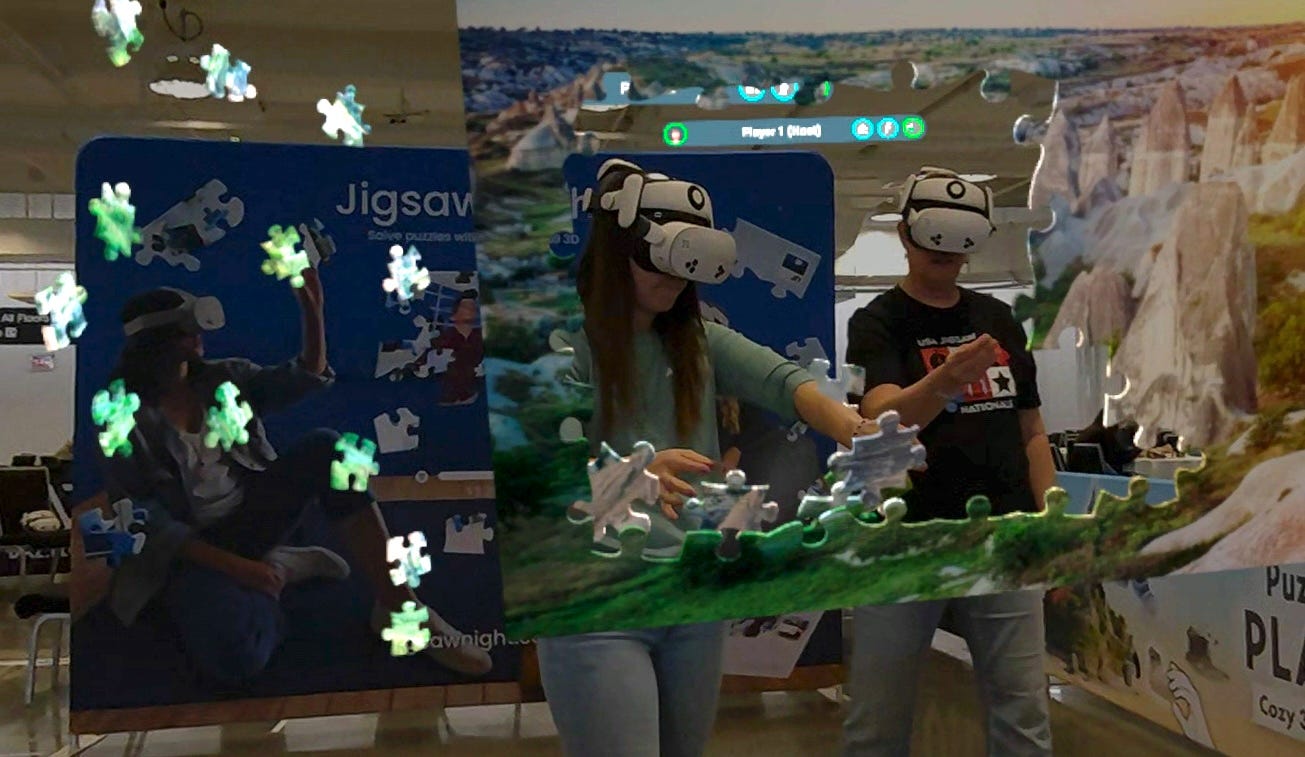
Attendees to the convention are about 85 percent female dressed in shirts with phrases like “Getting jiggy with it” and “Piecemasters” and “Puzzles are for everyone” and “Big fan of puzzles & human rights” and “Damn it! Fit!”
“The great thing about this community is everyone is very kind and genuine, very wholesome people, who just want to see each other do well. They’re all just very internally competitive,” Krasny said. “They want to do well. They’re all very high performing people. They pick up a hobby and they dive in deep and they do it really well, and they do that across many hobbies. And so they’re all really interesting, excellent competitors, but then very kind, wholesome people. Everyone here, like I said, likes to be competitive and they want to do this thing well, but we’re all reminded that we’re just doing puzzles. So no one takes it too, too seriously. And we’re all really happy to see each other do well and we’re happy to work together too cause you’re really, especially when we’re doing this as pairs and teams, we’re just hanging out with our friends really. It’s just like a shared pastime too…they get to come together and do a thing that they really enjoy with people that they really enjoy in a community that celebrates it.”
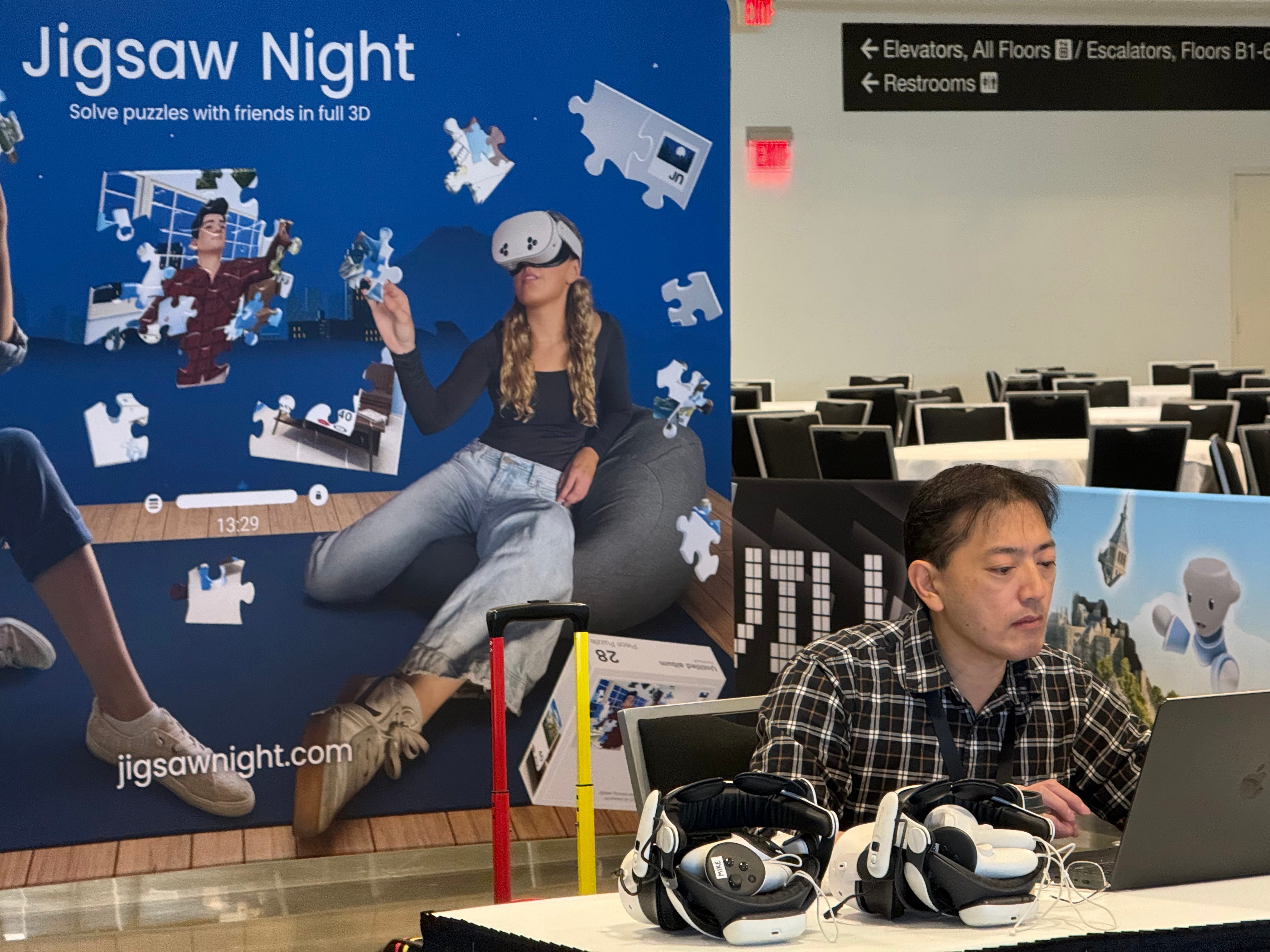
On Sunday at the convention Lukas sits at a table in the Villa surrounded by Quest 3S headsets with a nest of code showing on the MacBook M4 Max in front of him. Colocated multiplayer works in his game as does the new speed puzzling, but the “angels” system he and I have been talking about for weeks isn’t working yet. The idea is helpers (and journalists capturing video) should be able to roam the mixed reality play area and pop into different sessions to help players who might need assistance.
“My ultimate vision of VR…is copresent, multiplayer, whatever you want to call it by default,” said Owlchemy Labs head Andrew Eiche in an interview earlier in the week about his game Dimensional Double Shift, which opens its next dimension next month. “It’s not a metaverse. I think that’s where we keep getting hung up is like you push [players] the wrong way. You push them into a product….no, the operating system is copresent. So I can join you, Ian, in the default space. And then you go, ‘Hey, let’s jump into Dimensional Double Shift.’ And you open Dimensional Double Shift and it knows that it’s on my headset and we go together into Dimensional Double Shift. And if I’ve never made an avatar, it automatically takes the hyperrealistic avatar, converts it, and I hit a button or two and boom, now we’re in that experience together. And then we play that for a while. And then you go, “hey, we should play Walkabout. And you open Walkabout together, we jump to the next experience. It is a shared platform…stop trying to make a second place for me to make my games. Just make the operating system work, copresent.”
Eiche and Lukas are each working on very different products in VR but chasing the exact same idea. In the wake of Meta’s pullback from Horizon Worlds, Lukas’ rallying cry on the pages of Good Virtual Reality fuels him across this weekend.
Around 55 percent of people who visit the VR Villa over the weekend never tried VR before. A mother and daughter trying headsets for the first time noted that walking around in relaxed mixed reality was a relief after speed puzzling over a table.
“At AWE last year, someone asked me ‘so is your goal for everyone who has a headset to buy your game?’” Lukas explained. “And I said ‘no. My goal is for everyone who wants my game, to buy a headset.”
“If we want the space to grow, it’s no longer enough for us to merely participate,” he wrote. “The novelty momentum in VR is gone, and just following the next platform’s new thesis is once again not a guaranteed path to success. Even 100 games hitting $1m is also sadly not a rallying cry when billions have been put into this market. So if you’re building in VR just to service the market, stop here. Have fun, hope it works out for you. But if you take up the responsibility to expand it: Don’t build for other people. Build for you, and for people like you. Build something that you truly enjoy. If you don’t enjoy it, stop or pivot. Build something that other people enjoy. If they don’t enjoy it, fix it, stop, or pivot.”
Lukas took the red eye flight on Thursday night from California and walked straight into the Villa on Friday morning. By the end of the day with no sleep, his bloodshot eyes were blinking shut as he dozed, before he found a second wind by dinner time. Heading to bed around 9 p.m., he set his alarm for six hours but said he woke up after four to begin coding again.
Lukas’ sponsorship brought both the VR Villa and this journalist to Atlanta so I could bear witness. I woke up around 8:30 a.m. on Sunday to find a text sent by Lukas at 6:30 a.m.
“This is all the validation I need for doing what I do and choosing not to sleep,” it read.
You can find standout puzzling apps Puzzling Places from realities.io, Cubism from Thomas Van Bouwel, and Jigsaw Night from Steve Lukas on the Quest store.