Colocation Is Still A Puzzle To Solve For Good Virtual Reality
Jigsaw Night at the VR Villa presses Meta Quest to its limits.
ATLANTA — The puzzlers are ready. In front of each of them on their tables at the Atlanta Convention Center is a bag with a cardboard box full of pieces for a “previously unreleased” Ravensburger puzzle. Singles, doubles and teams are nervous and excited to tear open those bags and piece together what they find inside as fast as they possibly can.
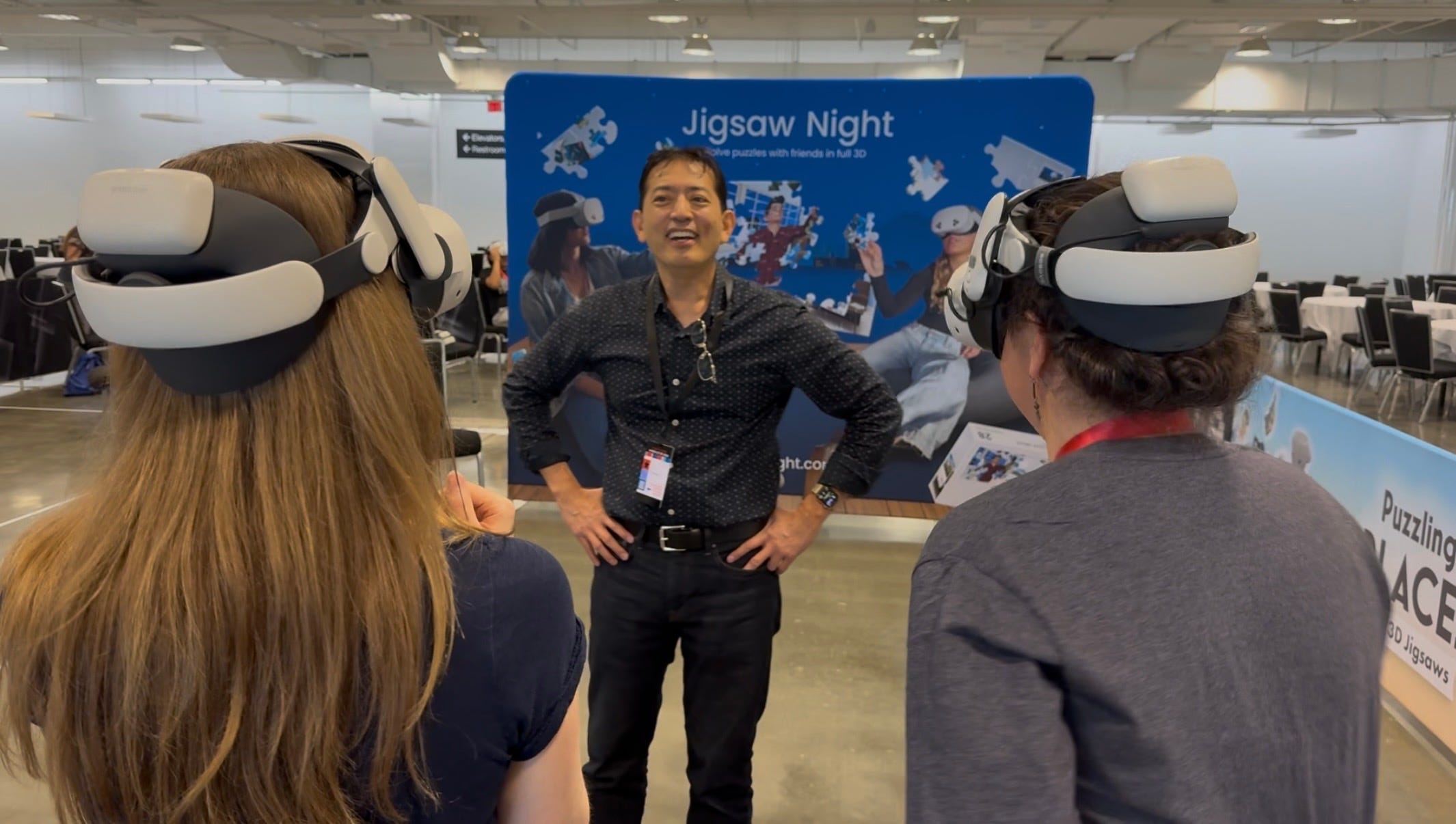
Good Virtual Reality passed through airport security sometime after 3 a.m. at LaGuardia Airport in New York to fly to Georgia and attend the VR Villa at the 2026 USA Jigsaw Nationals & Convention on a ticket sponsored by Jigsaw Night. The mixed reality app from Steve Lukas presses the limits of the Quest platform in an effort to realize colocated mixed reality and VR centered on puzzling with camera options and avatar customization that stretch the limits of Meta’s technologies.
“What I feel like I’m doing with those technologies is merely helping them achieve their potential,” Lukas said.
Below is a video shot on my Quest 3 showing the system with players colocated and piecing together a double-sided puzzle in the same digital reality. Lukas hands off his virtual camera to me in mixed reality while it captures pure VR as I’m simultaneously capturing my own view.
That the $300 Quest 3S headset and $500 Quest 3 can accomplish this at all is a marvel of modern technology, but the colocation unlocking the magic of experiencing the same shared digital reality still proves to be a little bit finicky, plagued by featureless floors and unexpected wireless interference. I saw similar issues at The Poly Awards over the previous weekend produced from an Unreal Engine-based project put together by Alex Coulombe’s Agile Lens.
“Meta still doesn’t make it easy…or reliable,” Coulombe wrote to me, noting that they haven’t performed the “non-trivial” overhaul to the latest version of Meta’s colocation system, which doesn’t appear to be supported in Unreal yet. “Our goal right now is to move off of any Meta dependencies we have and embrace full OpenXR standards whenever possible.”
The Poly Awards, in their 6th year, are an extraordinary undertaking attempting to pull in experts in VR technology on video calls alongside those situated together physically in a real New York theater while streaming it all out live on YouTube as it happens. The video below, also shot from my personal Quest 3, shows a moment when Agile Lens’ technology saw attendees in headsets toss digital confetti into the air as pictures of award winner Nonny de la Peña appeared to headsets centered on the physical stage with a traditional screen in the background showing the stream.
Coulombe and I effortlessly played pickleball colocated together late last year in a pair of Vision Pro headsets, but that experience wasn’t without a couple minor issues either.
Lukas uses Unity for his app with a number components inside he can use beyond this core idea of 2D puzzling in 3D space. The outstanding 3D puzzler in 3D space Puzzling Places is also available at the VR Villa alongside Thomas Van Bouwel’s Cubism and the new game Interlocked: Puzzle Islands, alongside a few others.
“People who gravitate towards video games and stuff may be more apt to do something like this, whereas if you are of a generation where the point was to sit down and do a puzzle without technology and be present in the moment, you’re gonna have two flavors of people here,” said puzzling competitor Anne Stockdale, fresh from Quest 3S after having her first experience in VR since the 1990s Virtual Boy. “When I come here, I’d love to video game and I love to do puzzles, so this is kind of a mesh of two worlds that I really enjoy. I see it’s got a place. It’s not gonna be for everybody, but it’s got a place in here.”
Stockdale’s comment highlights the dream both Lukas and Coulombe are chasing to produce good VR. The headset and technology should disappear so people together can be together and just be “present in the moment”.