

Steam Controllers Belong In Apple Stores & Apple Services Belong In Linux
We should be able to buy a Steam Controller in an Apple Store and enjoy Apple TV and Apple Music inside a Steam Frame.
My particular brand of hopium sees enough differentiation between Steam Frame and Apple Vision products to dream of both hardware and software solutions filling big holes in one another’s ecosystems. Without these holes filled, people will still encounter major reasons to spend their time with flat computers instead of VR headsets.
I’ve written, and then deleted, too many words dreaming of interactions between Steam Link and SharePlay that would enable everything from true LAN parties to co-watching movie parties and karaoke nights in headsets from different manufacturers. All that still seems pretty far away because there’s too much to protect and too much ground to gain by becoming the main provider of core technologies in spatial computing. Put another way, it’s too early for too much cooperation. There are, however, areas where clear gains can be made by both Valve and Apple.
Steam Controllers In Apple Stores
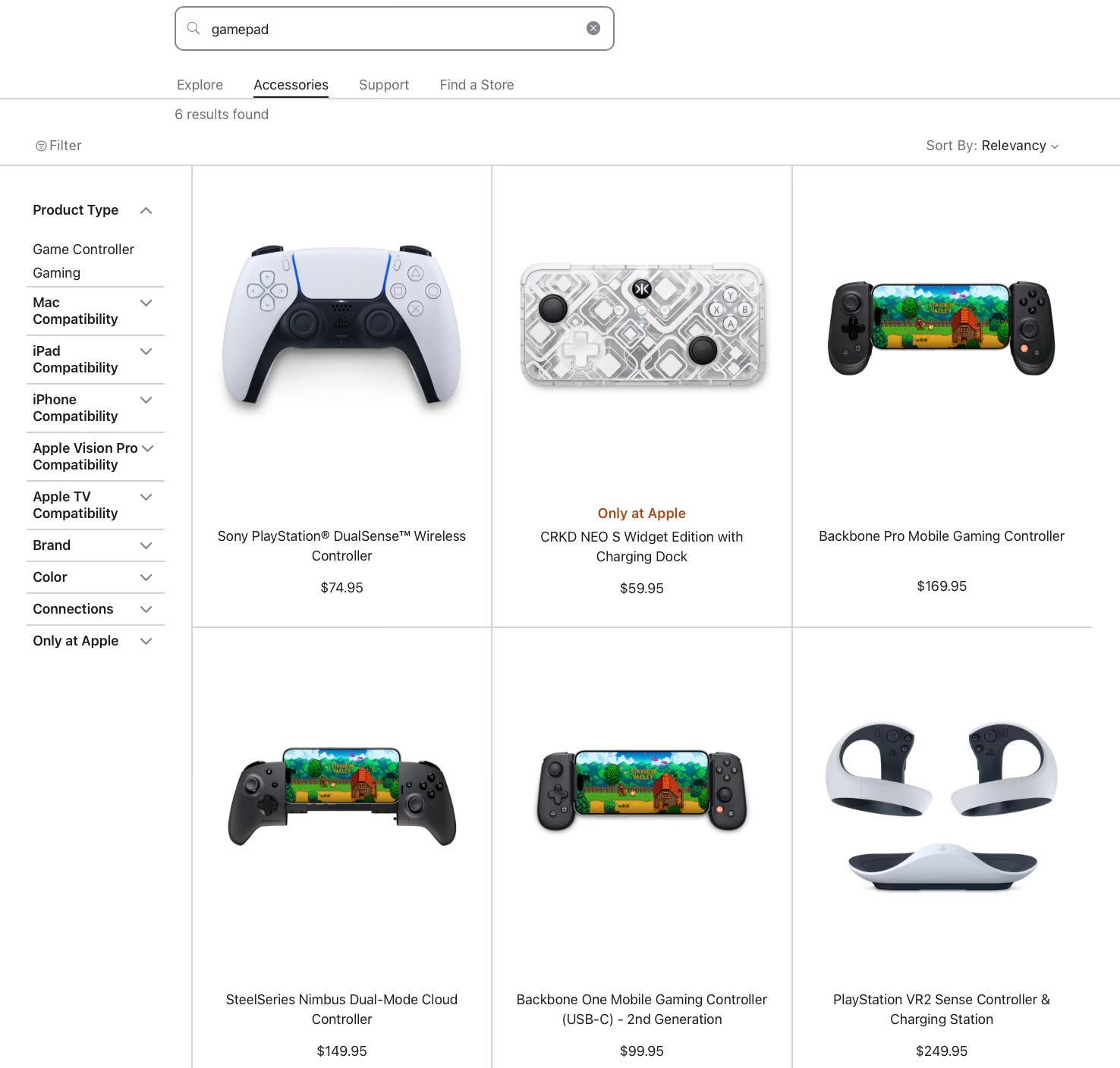
The new Steam Controller would be totally at home inside an Apple Store. Attaching the wireless transmitter and charging puck to a Mac would only make it better to spend time playing games with Apple hardware.
Doesn’t this seem like it belongs in an Apple Store?
Steam Frame controllers could be sold as a pair inside Apple Stores too. The PlayStation VR2 controllers have been sold out from Apple for months, meaning that the large ringed devices which aren’t as portable as the headset itself cannot even be purchased on their own to play games developers might be making for Apple. The ringless Steam Frame controllers, meanwhile, are small enough to transport in the side-carry Belkin bag inside which I carry the Muse pen.
“Apple doesn’t care about games” is only true until it isn’t anymore. And the space for software here is much bigger than “games” — it is about precision input and haptic feedback for both flat games and simulation in VR.
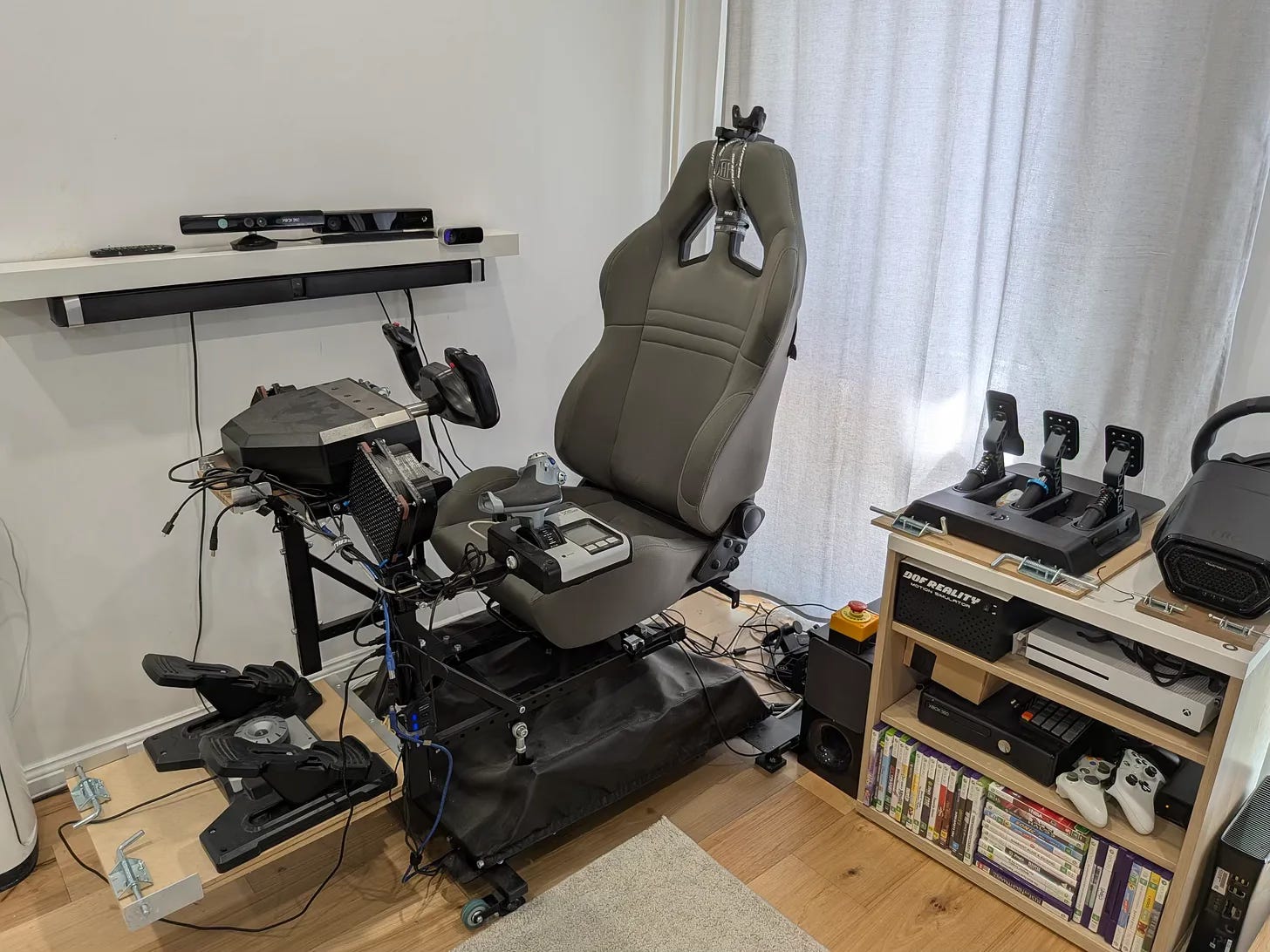
Meta’s controllers for the Quest ecosystem are attached to everything from putters to 3D-printed ping pong paddles to model guns to track the objects and bring them into software. You are showing bias and a lack of imagination if you think Apple’s disinterest in gaming as a subset of personal computing extends to the high-end simulation systems that train pilots and other professionals today. With X-Plane on the way and enthusiasts ready to shell out thousands of dollars for motion simulation rigs like the one SUPERHOT VR developer Mark Schramm has in his living room, this market is ripe for Apple to pick fruit by simply making high-end simulation a little easier to experience.
One way to do that is to supplant Quest controllers with Steam Frame controllers as a semi-standardized tracked object equivalent to a gamepad but more useful for scenarios like attaching to an object you want to track.
Given the absence of Sony’s controllers in Apple stores, the bottom line here is one of two things is very likely true. Either Apple put PlayStation VR2 controllers in stores to allow developers who purchased Vision Pro to prepare for next steps, or Apple is done with VR and that’s why the controllers are out of stock. If you believe the latter, why did Apple add an M5 chip to the Vision Pro in late 2025 and build a new operating system to just to abandon it after shipping a Pro device in one category? If you believe the former, do you think it likely Apple is going to make its own tracked controllers? That would be interesting to see, but I propose that with Apple operating as a protective layer between developers and users for hand tracking and eye tracking the company doesn’t really need to “own” gamepad input. They want to be the provider of games you use your eyes and hands to control and that leaves space for Valve, Nintendo, and other gamepad makers to sell their wares inside Apple stores to accessorize Apple spatial computers while still profiting from core interaction with the headset.
Apple Subscriptions In Linux
Apple Music and Apple TV subscription services would both improve the experience of working with Linux computers while simultaneously feeding more eyeballs and ears and revenue to Apple and the artists who make content locked inside those services.
It is not in the interests of Valve or Apple or their paying customers to encourage a process of seeking APKs to install from untrusted sources on devices like Steam Frame. Trust is likely one of the reasons Steam hosts the latest version of its Steam Link APK directly on its support site. People using an Android-based device who don’t want to, or can’t, use Google Play for some reason have a trusted place to look to find the software and gain access to their Steam streaming game library. Google is looking to verify APK developers starting this month for pretty much the same reason.
This brings us to Flatpaks — a distribution system for applications in Linux that, when uninstalled, returns the operating system to the way it was before installation. Valve is a big believer in Flatpaks and, if Apple would test those waters with its protected content, it would have a surface outside Google and Microsoft’s grips to deliver revenue-generating services onto any Linux-based device. How exactly Apple makes its digital rights management schemes work inside Linux is not my problem to solve, but when I’m in Steam Frame I don’t want to go looking for bootleg Android apps in order to listen to Apple Music or watch Apple TV while playing games.
I should be able to just install those services to my Steam Frame and, ideally, play a flat game from Steam while watching a streaming movie from Apple. That’s essentially the inverse of the experience on Apple Vision Pro today streaming a game from Steam while watching a downloaded movie from Apple. For those who might look at this and argue that nobody actually needs this kind of multitasking, I question whether you are being honest about your media habits using multiple traditional flat screens in the physical world in tandem with one another.
Chipping Away At Microsoft & Google
What I’m describing here are simultaneous wins for both open and closed computing that can be won by more collaboration between Apple and Valve. Open wins by flatpaking apps for use in spatial computers without the involvement of Microsoft or Google or Meta by routing around their platforms, puts quality content in more places, and helps popularize a more open method for distribution. Closed wins by putting an unbreakable digital rights management shell around digital content that you lose access to the moment you stop paying for the subscription.
Meta exits the Quest 3 era with little more than 1 million subscribers paying for a monthly fee to access the best places in VR. Knowing Meta’s history in this space, I expect them to allow games that don’t see many users to disappear from the subscription while lowering the cost to subscribe and subsidizing future development and long-term exclusivity agreements from the apps on the service that see the highest engagement. After Google swiped the HorizonOS third-party headset market from underneath Meta — with AndroidXR the likeliest platform now to be used by Sony or Nintendo in making VR headset consoles — the Horizon+ subscription service is the only thing Meta can used as leverage to try and force itself into a data-gathering layer at the base of VR and spatial computing.
Meta’s pullback here was predictable by both Apple and Valve. Meta made product after product that was too heavy, too low-powered, and too disconnected from the things you actually need and want when you’re wearing a headset. Apple and Valve are filling the void with their own products that are still walled off from one another in some ways. By not capitalizing on this moment through cooperation, they leave an opening for Meta to regroup itself as a much leaner effort that can still try to establish itself as a foundational layer inside their machines.