

Meta Needs To Make Amends To Horizon Worlds Creators
Creators didn't build in Horizon Worlds because of Meta. They built despite Meta. And they deserve more than a company that only listens when it's scared.
A few days ago Meta announced a kill date for Horizon Worlds VR. Then, after hundreds of XR and tech professionals joined together to share their horror and outrage at what Meta was doing to its creators, they walked it back on an Instagram story. That is not an apology. Let me show you what one looks like.
I was gutted and then volcanic. Almost 600 of you joined me. I wrote what I felt and over 80,000 people read it. Then Meta CTO Andrew Bosworth does an Instagram AMA and casually mentions they’ve decided to keep it “for the foreseeable future”.
I don’t think this is cynical, but it is unusual. I think someone inside that company flinched. I think somebody still has a conscience in there, even if the response appears performative too. That flinch matters. But a flinch is not repair.
Whoever inside Meta felt something when hundreds of XR professionals lit up in horror, I am speaking directly to you right now: take another step. And another. Because walking back a kill date on an Instagram story is not accountability. It’s the first inch of a mile you haven’t started walking yet.
I am not grateful for a stay of execution. And I am not trying to burn down whatever nerve is still alive inside Meta. I am here to say: prove it. Because right now, “for the foreseeable future” dropped casually on an Instagram story could mean you’re listening. Or it could mean you’ll do this again, quieter, when the world is not watching. Show us which one it is.
This feels like psychological torture to the people who put their hearts into building places in Horizon Worlds. Stop it.
Let me tell you who you are harming.
Please note that throughout this piece I am linking to entire worlds people made in Horizon which you can visit. These sites are actual places in VR and they will become dead links in the years to come if Meta kills Horizon Worlds after the future their leadership is able to foresee.
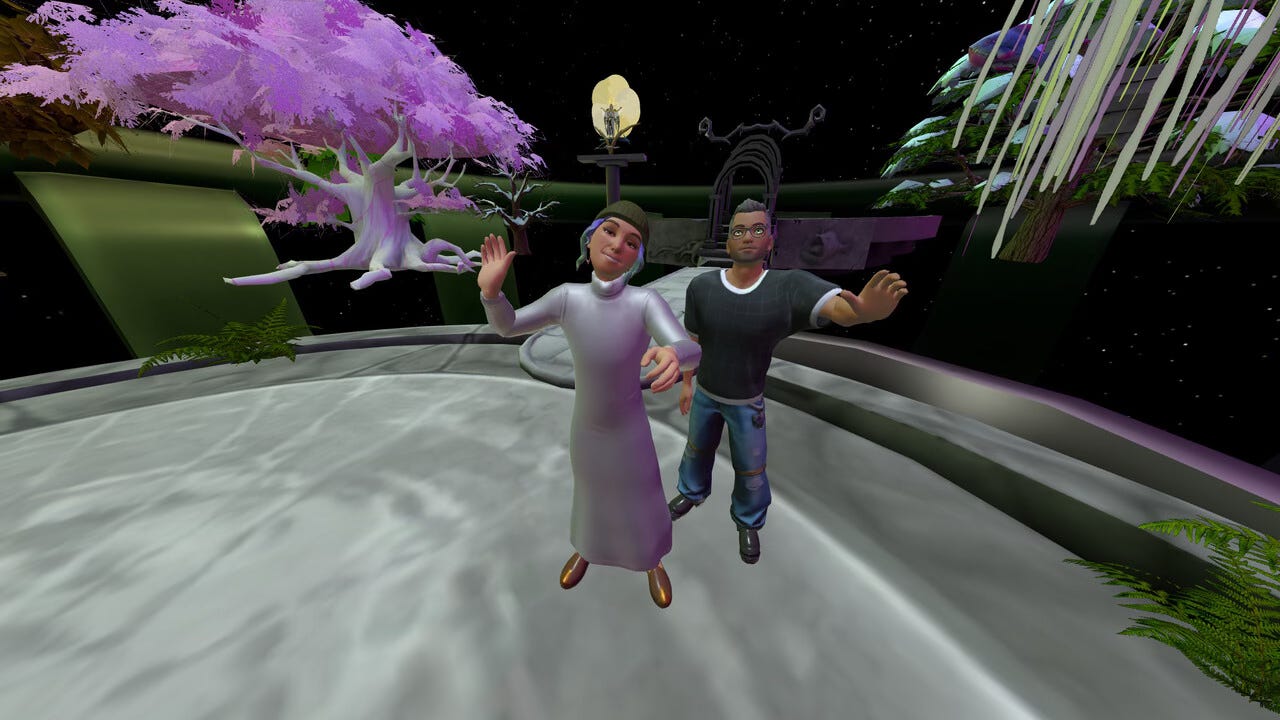
Lacey is an amputee. Years ago, in a community I designed called the Horizon Creator Community, he built an interactive world called “My Journey”, a walkthrough of his below-knee amputation, his dozens of surgeries, and his dream of navigating a kayak someday if he could get himself walking. He showed up cognitively compromised. He struggled for months to learn the creator tools. But with community support, over time, he learned. And then he kept going. He collaborated with sound artists, environmental artists, and community members to build sacred geometry galleries, fantastical Star Wars-meets-Willy Wonka space rides of playful, trippy, healing experiences. He built The L.I.T. Gallery, a world synthesizing art, sound, and community into something that cannot exist on a flat screen.
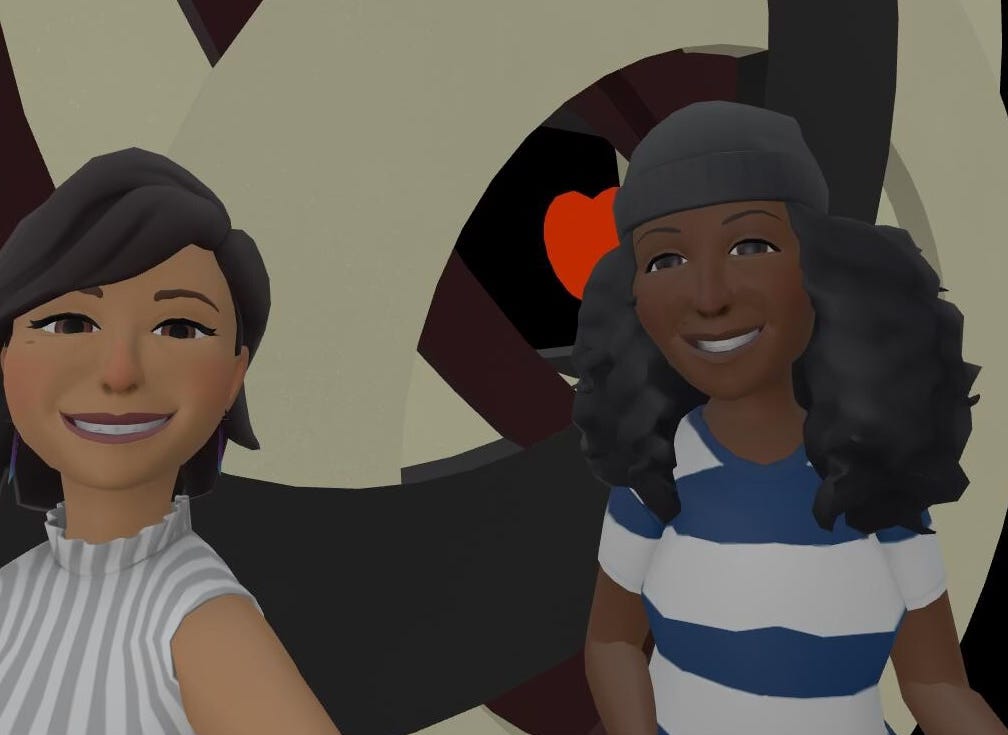
Bizerka identifies as having a severe seizure disorder. She also came through the HCC, where she connected with supportive creators and built “Salvage”, an experiential journey through the underground railroad from the perspective of enslaved people. She persisted in this effort despite waves of criticism from people in both the wider Black and white communities who considered her work too serious for VR. She later built a world describing her seizure condition, which brought the community closer to understanding her and supporting her. Like Lacey, she showed up compromised, struggled for months to learn the tools, and with community support eventually learned enough to build her own waves, manifesting her dreams and bringing all kinds of people together in a common cause.
Both of these creators, two of hundreds I supported and nurtured in their first community and building experiences, started by describing their pain. They ended by creating worlds that healed other people. That is what VR community does when it works. That is what Meta announced it was demolishing two days ago. And that is what “for the foreseeable future” on an Instagram story is supposed to fix.
It doesn’t.
Here’s what making amends actually looks like. I built a framework called AMENDS to help communities repair harm. I train leaders in it. BridgeMakers Cooperative, my community in VRChat, has a wisdom world where people can pick up these cards around a fire and talk through how they’re going to do better. This already exists, in VR, on a platform that’s still standing. Meta, here’s one more chance to do the move where everyone wins:
A, Acknowledge what happened. Not “we’re separating platforms for focus.” Say what you did. You told creators their life’s dreams and thousand of hours building community and environments would be inaccessible in 90 days. You did this through an email and forum post. You did this after years of telling them to build, invest, trust, and belong.
M, Map the impact. Creators like Lacey and Bizerka found a medium where their bodies and conditions weren’t barriers. Communities that used VR for healing, connection, and cultural expression. People who can’t even locate their own creations in your broken search engine. Don’t tell us what you’re “focused on.” Tell us you understand what you broke.
E, Express understanding. Not “we heard your feedback.” Show that you understand why announcing the demolition of embodied spaces where people healed is not a product update. It is institutional harm. The fact that you didn’t know that before you made decisions and posted it is the problem.
N, Name what needs repair. Specifically:
Fix your search engine. Creators cannot find their own worlds. That has been broken and that is unacceptable before, during, and after any transition.
Repair and maintain the basic creator tools so the people who built your platform for you can continue to access and maintain their work.
Give creators full ability to export and move their worlds, complete and intact, to other applications. Unwall the gardens before you abandon them.
Release the application to the community as a cooperative open-source project, the way Tilt Brush turned into immortality for its creators by using open source to become, through community, MultiBrush and Open Brush, a VR art tool that thrives because Google let the community steward it. If you don’t want to steward what creators built, let the creators steward it themselves. BridgeMakers Cooperative would volunteer to help coordinate this effort.
Give creators a seat at the table where these decisions get made. Not a community forum where they find out after.
Issue a public apology taking responsibility for the egregious treatment of creator content, for breaking promises, and for the psychological safety you manufactured to get creators to trust you after years of broken commitments. Not a product update. Not an Instagram story. An apology.
Share a plan of action. With timelines. With names attached. With accountability built in.
D, Demonstrate change. Don’t reverse course only when people get loud. Change the structures that made this possible. How are creator investments protected going forward? What happens when you pivot again in six months? Show us the policy, not a response to press. Not an Instagram story.
S, Stay in the conversation. This is the one Meta has never done. You don’t get to announce, retreat, drop a casual “for now” on an Instagram AMA, and go quiet. The people you harmed are still here. The conversation doesn’t end when the news cycle does.
Meta has clearly shown they never understood the value or the responsibility of what they built and lured thousands to build with them. This is so much worse than Spark AR and Horizon Workrooms because of the nature of self-made immersive worlds, the hype of competitions that lured people in, the careers and lives that trusted Meta and then were tossed aside by a company that is too big to care and too clueless to understand what it held.
This is wrong. Do better.
To everyone reading this, I am asking you to act.
If you work in XR, in tech, in community building, in policy, in journalism, in any position where your voice carries weight, do not let Meta turn a stay of execution into a redemption story.
Demand the apology. Demand the plan. Demand export and open release.
This is a moment where a company that spent tens of billions of dollars, and convinced thousands of creators to pour their lives into a platform, is now treating their work as disposable. They need to hear from people that this is not acceptable.
Creators didn’t build in Horizon Worlds because of Meta. They built despite Meta. And they deserve more than a company that only listens when it’s scared.
Perfection is a myth, but accountability is not. Being people-first demands more humanity than this kind of treatment.
This is not the same as another app closing. Let me show you what Meta was holding.
TechCrunch reported the reversal and opened with this: the walk-back “should come as a huge relief to, like, five people”.
Here are some of those “five people”:
Alcoholics Anonymous groups have been running VR meetings in Horizon Worlds for years. An organizer said that hundreds of people have been put on the road to recovery through these meetings. When AltspaceVR shut down at Microsoft, those meetings migrated and they were about to be displaced again. People in active recovery just had their meeting space threatened with a 90-day eviction notice.
Living Hope VR Church holds weekly Sunday services, Bible study, and a live podcast. For people facing marginalization in the physical world, this church became a refuge.
HouseCall VR is an immersive healthcare education hub where patients could learn about their conditions through interactive exhibits.
Jeremy and Joy Duncan built “Joy in the Morning,” a talk show voted World of the Year and Best Podcast/Talk Show World in 2023 by Meta’s own community.
Karen Stritzinger, ex-Meta/Oculus developer, founder of Old Hara Studios, and environmental justice organizer, built gamified worlds on ecological conservation and climate solutions, including “Urban Coffee Farm” demonstrating urban farming and the 15-minute city, and collaborated with the University of Oregon on “Virtual Excursions for Science Learning,” an educational plankton research simulation. She is now working to help creators find ways to preserve and port their worlds. This was not a hobby. This was research infrastructure.
A former Meta employee wrote in the comments of my original post: “Our team was piloting VR-enabled, data-driven health and wellbeing programs that decreased stress, increased health and movement, and provided virtual community spaces for our Metamates. It was all killed in the Year of Efficiency.”
Logan Johnston, a former Meta Scaled Partnerships Lead for Creator Economy, wrote publicly: “I can barely find the words. I was an advocate for years for Meta’s mission. Now I feel like I’ve personally let a lot of creators down.”
These are more than a handful of people. These are recovery groups, churches, healthcare hubs, climate research sandboxes, cultural spaces, disability communities, talk shows, art galleries, and healing environments. This was not just a hobby space or a social hangout to them. This was a sandbox for trying to solve humanity’s problems. Thousands of hours spent by highly educated, deeply skilled professionals collaborating and dreaming and problem-solving some of the hardest situations facing us, using the most powerful communication medium ever built. And Meta just told all of them their work had a kill date, then told them on an Instagram story to be grateful it was delayed.
This is not the same as Spark AR shutting down. This is not the same as Horizon Workrooms. The soul of Supernatural left when its coaches were laid off and the software was put in maintenance mode, but the place still exists and wasn’t given an expiration date. This is not like game studios being shuttered, or hundreds of Reality Labs employees being cut. Each of those was a wound. But this, the elimination of embodied spaces where people healed, recovered, worshipped, researched, found community, and built entire lives, this is different. VR is not a screen. You cannot flatten these experiences onto a phone and call it a transition or a focusing move.
This is erasure.
If you leave a comment on social media, or directly under this article, know that real people share in your experience, will see your words, and will be affected by them. The Internet is large, but it is not inhuman or without love, and words have meaning that touch people you may never see but may know you anyway.
 | A guest post by
|
"If Meta can burn your house down, it was never your house to begin with"